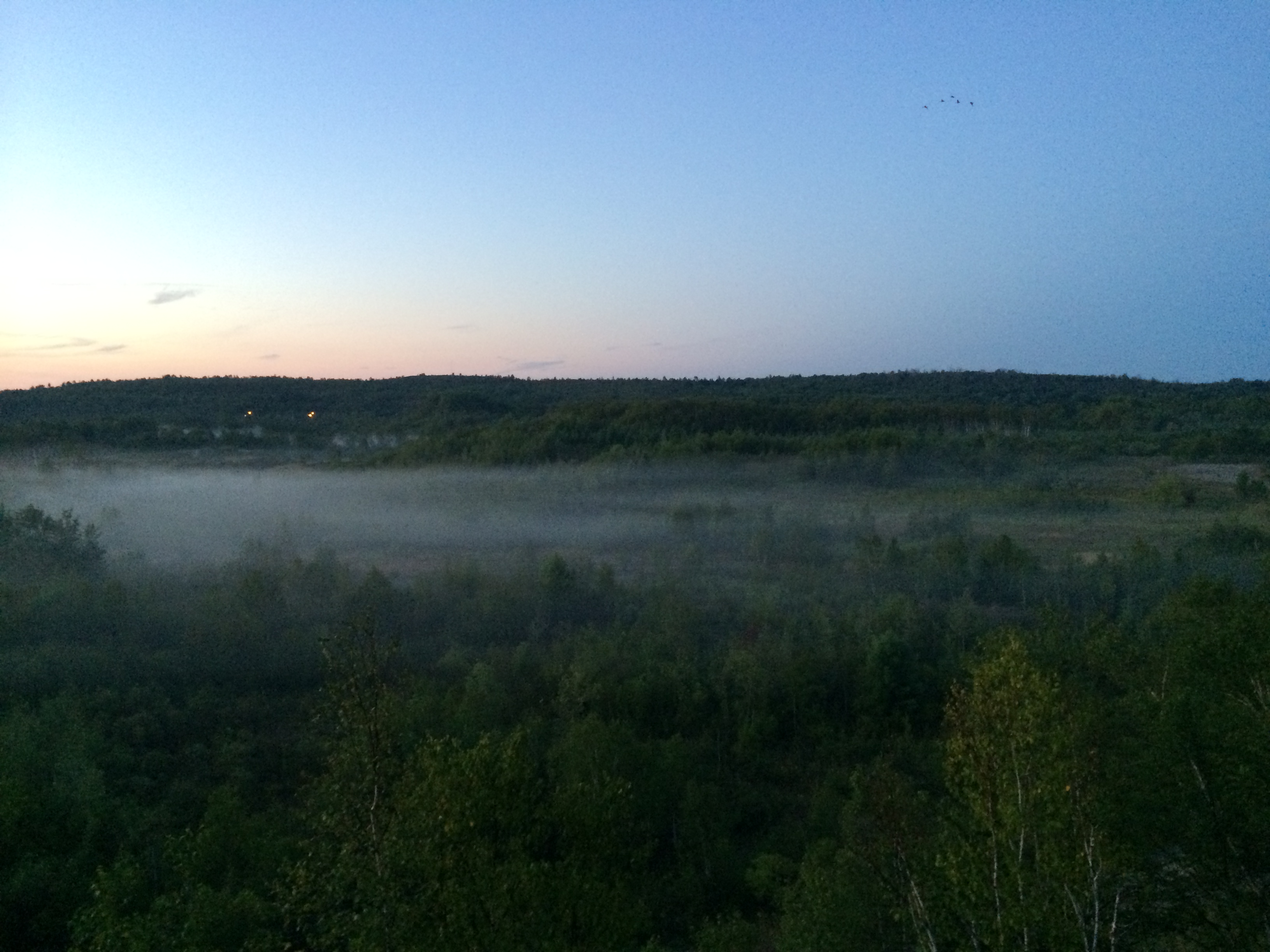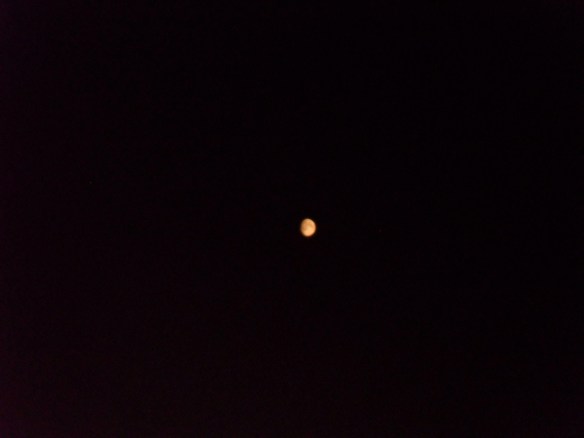
The Lunar Eclipse

On October 8, 2014, a lunar eclipse occurred in North America, and Oceania. This eclipse is the second of four consecutive total lunar eclipses occurring in 2014-2015.

I missed the first eclipse because that night in Toronto was overcast with a thick cloud. On that night, the forecast looked bleak with clouds clearing only around 6-7 am, when the eclipse was underway. Some forecasts say that it would remain cloudy for the whole night. Despite the high probability of cloud, I decided to go and observe anyway.

I arrived at the bus depot near the Markham Fairgrounds at 5:00 am. It was completely overcast, although there was a break in the clouds at that time. In that break, I believe I saw the beginning of the eclipse at that time, but I am uncertain about that. After I captured a few shots of the Moon, the clouds covered the night sky.
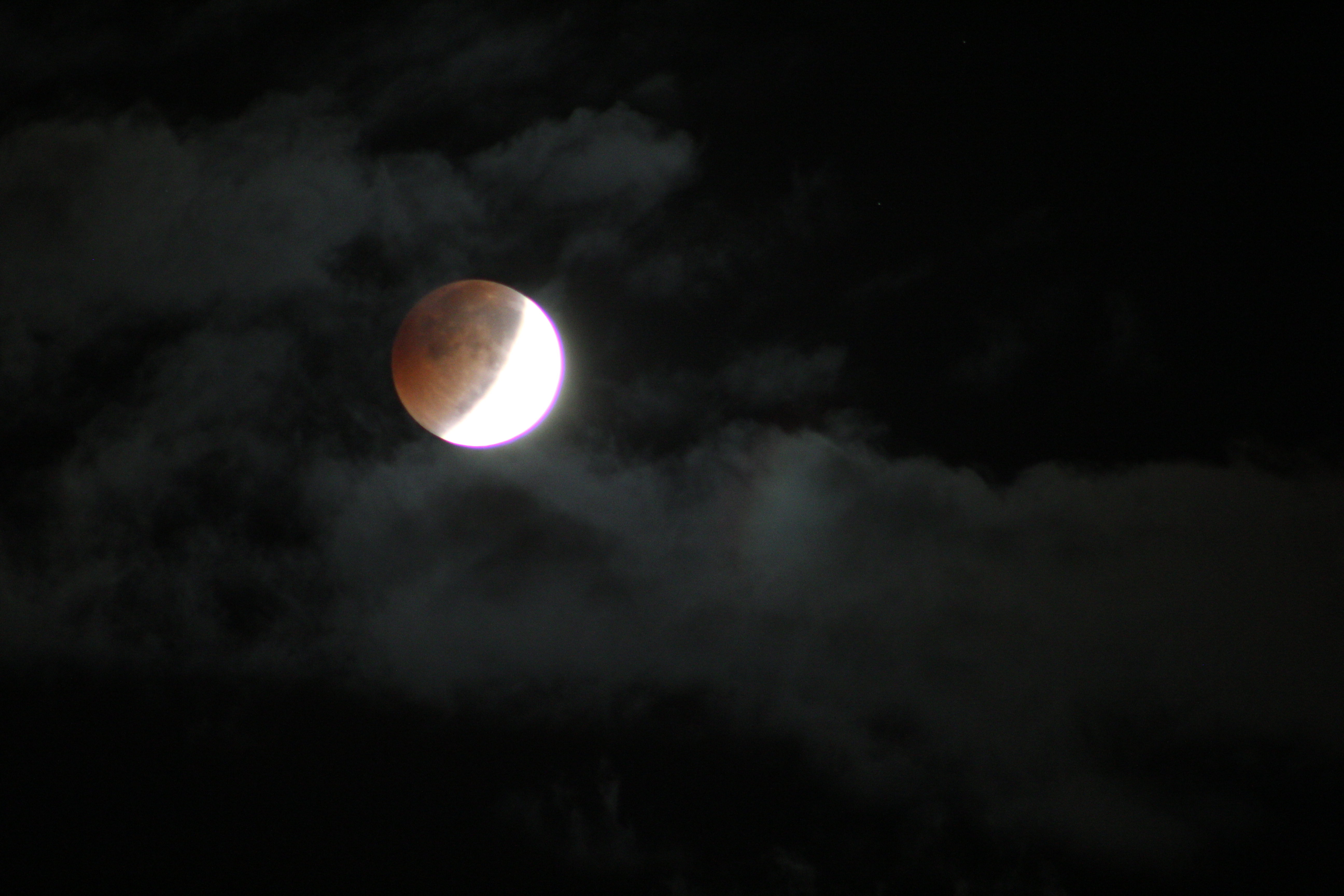
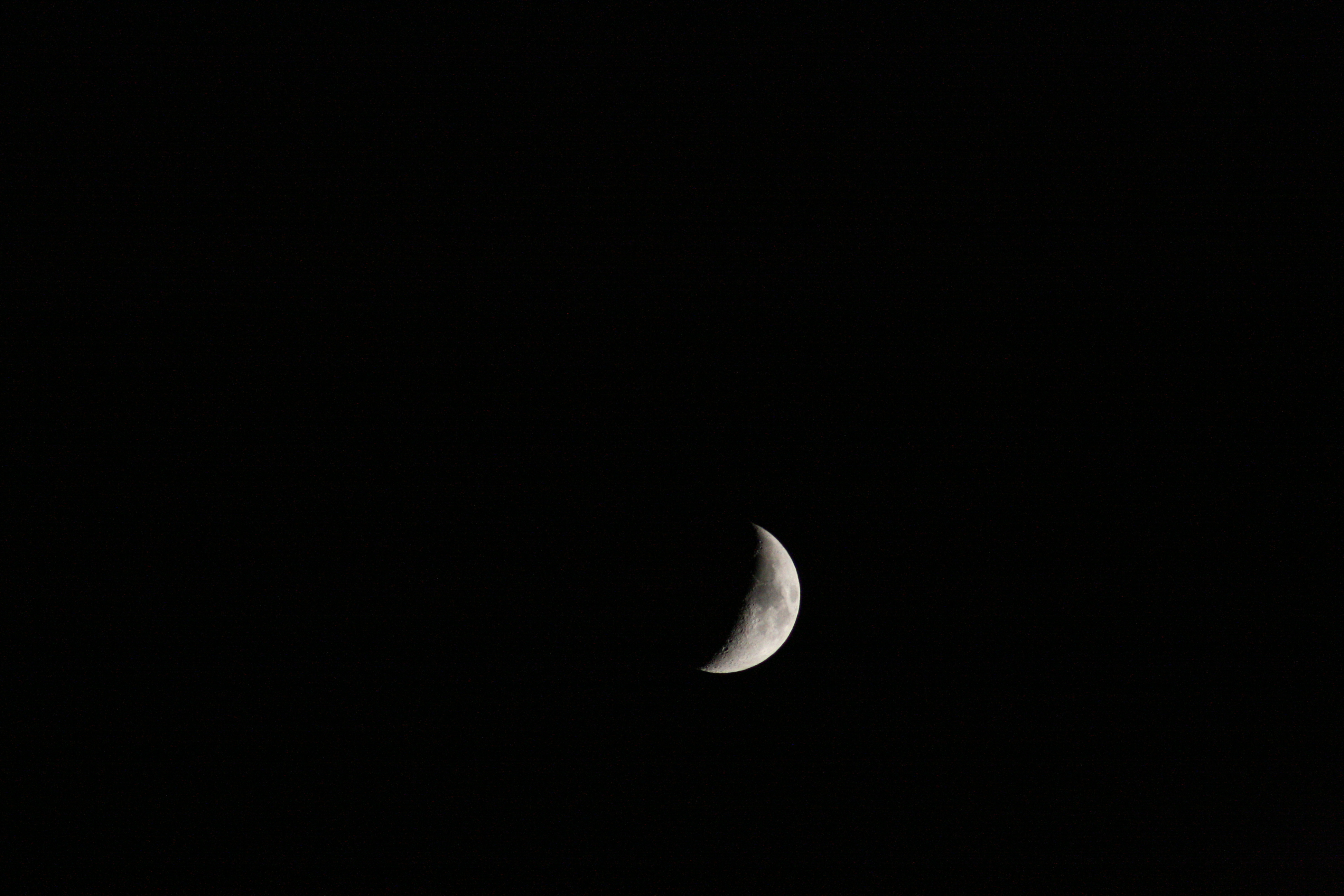
IMG_9636

Partial Phase of the Lunar Eclipse. 5:59 AM

After waiting a while for the clouds to clear, I elected to leave that area and come back in 30 minutes, once the clouds cleared up a bit more. However, on the road back home, I saw a significant break in the clouds and I drove back to the spot. When I arrived there, the clouds opened up slightly to reveal some of the stars. In the distance, I saw a sort of divide between the clouds and what I assumed was another set of clouds. As the clouds moved eastward, I noticed that the divide was an opening between the clouds and the sky.

Eventually, the clouds moved far enough that the eclipsing moon became visible. I soon began imaging it playing around with the settings, experimenting with what created a great image and what created a flawed image. It was an amazing experience to not only capture but to view a lunar eclipse.

IMG_9717

Partial Lunar Eclipse Phase. 6:26 AM

As the Moon descended towards the atmosphere, I decided to get a clearer view of the horizon. I grabbed the camera and headed into the Bus Depot. There, I got a clearer view of the horizon, and the eclipse as well.

IMG_9757

Lunar Eclipse 6:39 AM

The eclipse lasted for many hours until sunrise. As the Moon descended deeper into totality, the sun starts to rise, which obstructed the view of the Moon in totality. At around 7:05 pm, I couldn’t see the Moon anymore. At that time, I decided to go back home.
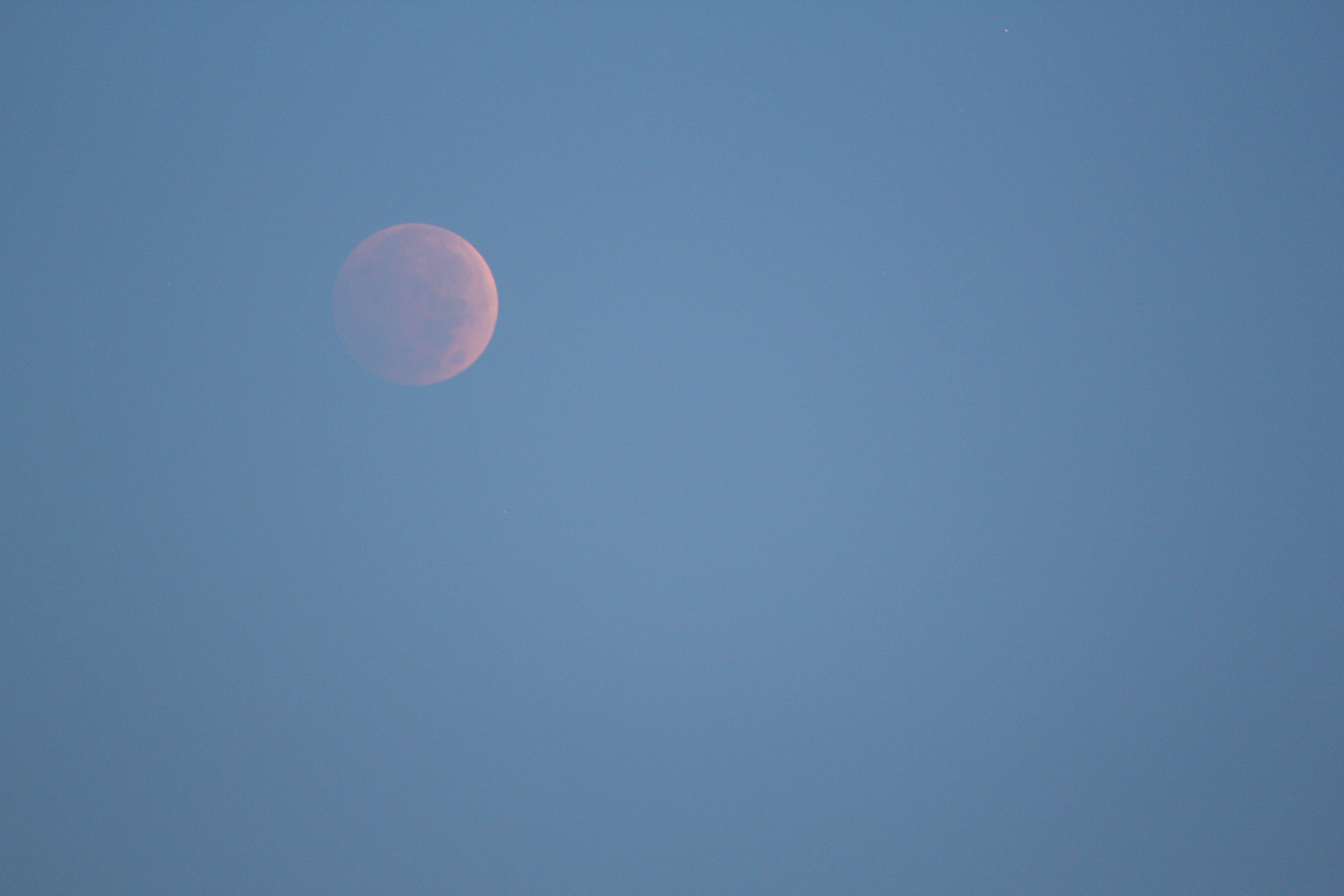
IMG_9803

Lunar Eclipse in Totality 6:52 AM

Looking at the photographs, I also realized that I may have imaged Uranus as well. I compared the image I took with Starry Nights planetarium software, and I couldn’t confirm whether I imaged a star or Uranus with the reddening Moon. I then compared my image with another person’s image, and I saw that there was a blue star near the moon in a similar position to the other person’s image. There were other stars, but they were not a sky blue. I suspect it is Uranus, but I cannot be sure.

EDIT: A friend of mine confirmed that the dot is indeed Uranus. 😀

IMG_9717 - Uranus_arrow

6:26 AM with Uranus circled.

Whoever saw the eclipse, in Toronto, were lucky that the clouds cleared up. I had a great time imaging the eclipse. I invite anyone who saw the eclipse to share their experience on the comments section below.


Keep Looking Up!

Star Trails from Glen Major

On September 27, 2014, my father and I drove to Glen Major Forest in Clairmont to image the night sky. The sky was so clear, that we could see the Milky Way ever so slightly.

We quickly set up the camera on a standard tripod. The camera had a 10 mm wide angle lens. After fiddling with the image settings, we decided to take 30 second exposure images at f/4 and ISO 1600.

I set up the intervalometer to take consecutive images for as long as it can. It started imaging at around 10:00 pm.

My father and I left the camera alone to do its work. During that time, we talked about the telescope, and how we can repair the tracking problems. We formulated a plan to fix the telescope’s tracking abilities, and hopefully we will be able to get the best result from that plan.

At 10:52 pm, we checked the camera and we realized that the battery died. As a result, we packed up and drove back home. We came back home with 81 frames to use for the image I had in mind.

The next day, I stacked all the pictures using a program I downloaded from Startrails.de. This program stacks the images that one loads into the program and creates an image. This program doesn’t adjust the image in any way, therefore, it creates what is known as a startrails image.

These images below used two different methods of post processing. For the first image, I used FastStone Image Viewer to convert all the images from .CR2 (Canon Raw File) to JPEG files, which I used to create the startrails image below.

Sept_27_2014_GM_Startrails3

For the second image, I used UFRaw to convert each image into TIFF files, which I used to create the startrails image. This startrails image below is darker than the first image because of how UFRaw processed each image. Sept_27_2014_GM_Startrails_1

In addition, I also made a timelapse video of the stars’ movement in the sky. It felt astounding to see the actual movement of the stars in the video I made.

This is one of the many kinds of images that you can capture with a DSLR camera. The night sky is full of amazing objects and phenomena that always makes the heavens a dynamic place to image.


Keep looking up!

Dark Skies at Long Sault

On Thursday, September 25, 2014, RASC hosted its monthly dark sky party at Long Sault Conservation Park. After all my work was done for the day, I decided to take the 45 minute drive there.

I arrived at Long Sault Conservation Park at 11pm. Most of the observers have left, with only a few left. Looking up at the sky, I saw so many more stars than at home. I also saw the Milky Way. Unfortunately, the Galactic Center was not visible at that time. I met whoever were left, and I saw what they were seeing. They were doing amazing work.

One observer, who came from downtown Toronto, showed me his setup. When I met him, he was looking at the Andromeda Galaxy. He let me peek at Andromeda through his telescope, and I saw a dull, fuzzy, and dim dot. It was barely visible.

I stayed until 11:30 pm, looking up into the sky, staring in awe of the beautiful, Milky, stream of stars in the sky. After that, I left for the long drive back home.

While my trip was short, it was fruitful. I finally saw how beautiful Long Sault Conversation Park is, and I saw the Milky Way. I hope to one day come back with my telescope and take more photos of the night sky there.


Until then, Happpy Observing!

Astronomical Events for October 2014

Hello everybody,

Here are the astronomical events occurring in the month of October: (All times are given in UTC format)

       Astronomical Events

  • October 4: 1 Ceres passes 30′ north of Saturn.
  • October 6: Draconid Meteor shower, which is hard to predict due to a high variability of rates and timing, is not likely to be seen due to a Full moon.
  • October 8: A total lunar eclipse will occur at 10:56 UTC. It will be visible from the Pacific Rim. Here is an image that shows where the eclipse will be visible from. Anything east of the intense red shading, means that the Moon will set during the eclipse. Anything west of the intense red shading, means that the Moon will rise during the eclipse.
    path720

    Where the Eclipse will be visible from.

    In addition, Uranus will be a degree away from the eclipsed Moon. Check it out!

  • October 13: The Moon reaches its shallowest northern declination at +18.5 degrees.
  • October 14: Comet C/2012 K1 PanSTARRS may reach magnitude 5.0 for southern hemisphere observers.
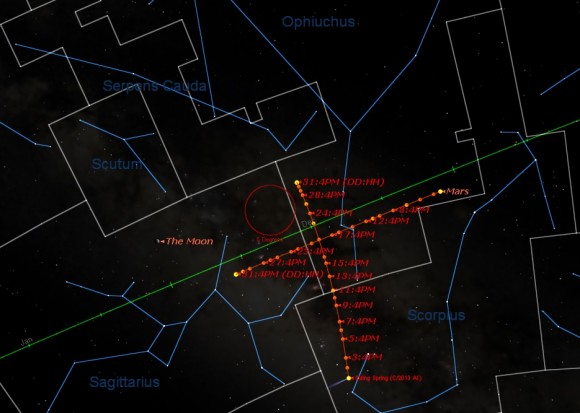
  • October 19: Comet C/2013 A1 Siding Spring passes just 7′ from the planet Mars. The Globular cluster NGC 6401 also lies nearby. The comet’s periareion (Periapsis on Mars) will be from 138,000 – 141,000 km from the surface of Mars. It will reach periareion at 18:28 UTC. To compare the distance, Mars’ outer moon, Deimos orbits at 24,000 km from the planet. It’ll be pretty far away, but on the surface of Mars, it will have a brightness of magnitude -6. That means it will appear to look as bright as Venus from Earth.  Check it out!

    Path of Mars and Comet Siding Spring

    Path of Mars and Comet Siding Spring

  • October 22: The Orionid meteor shower will peak at approximately 5:00 UTC. It will be best viewed in the Americas. It will be good, since the Moon is at a waning crescent phase.
  • October 22: The Moon will occult Mercury in Australia 24 hrs prior to New Moon.
  • October 23: A partial solar eclipse will take place. It will be visible in North America. It’s greatest eclipse will take place North of Nunavut, at 21:46 UTC. Make sure you get proper eye protection to see the solar eclipse. Don’t miss it!!

    599px-SE2014Oct23P-580x580

    Path and Visibility of the Eclipse.

  • October 25: The Moon will occult Saturn for the Northern Atlantic at approximately 15:43 UTC.
  • October 25: The Moon will reach its shallowest southern point for 2014, at a declination of -18.6 degrees.


WORK CITED

101 Astronomical Events for 2014

http://en.wikipedia.org/wiki/C/2013_A1

http://mars.nasa.gov/comets/sidingspring/


WORKS CONSULTED


http://en.wikipedia.org/wiki/Apsis

Early Night Conjunction

On Sunday August 31, 2014, early in the evening, Earth’s Moon and two planets were positioned just right to form a conjunction. This conjunction was made up of the Moon, Mars, and Saturn. The moon was past its first quarter phase, but Saturn and Mars were past opposition and were starting to set earlier.

At home, I borrowed my dad’s DSLR camera, and his tripod to take pictures of the conjunction. I had to act fast as the conjunction was setting very quickly. I quickly took the pictures, using a mid-level exposure rate, with the f/stop at maximum, and the ISO level at 1600. I was satisfied with the images I took.

IMG_4639

Conjunction of the Moon, Mars, and Saturn. Mars is at the bottom, Saturn is on the Far Right, and the Moon is near the center of the image.

While I was taking the images, two of my neighbours, who were walking down the street noticed what I was doing. I showed them what is going on, the pictures that I took, and told them where to find a few tools to get started on their own. They were very intrigued by my stargazing. They soon went back to walking, talking about what I showed them.

Soon after, the conjunction was too low in the sky to image anymore. The western sky at my house was obstructed by my neighbours’ houses. Therefore, I decided to take a few pictures of the Moon. The first few pictures were very overexposed, but after adjusting the settings a bit, I got a good clear image of the Moon. I had to expose it for 1/800th of a second to get a good picture.

IMG_4652

The Moon exposed to show planetshine. The light on the left of the Moon is called “ghosting” It’s when the flipped light of the image that is reflected onto the CCD Chip is also captured. Notice how the moon and the ghost moon are mirror opposites.

IMG_4638

The Moon.

I soon had the idea to follow the movement of the Moon. I decided to take many pictures of the Moon, as it was moving across the night sky. It gave me a new perspective on the movement of the Moon, the solar system, and our own movement in the cosmic scale.

After taking those images, I decided to take a few 30 second exposures of the sky. The images were trailing, but it looked good after stacking them together. I also made a very quick video of the star trails moving across the night sky.

IMG4713-6-Startrails IMG4713-6-Startrails2


Once I got the pictures I wanted, I packed up, and went back inside. It was a successful night of imaging. I got a few pictures of the Moon, the conjunction, and the star trailing. I also was able to make a video using those images. Hopefully, I can capture better images next time. Until then, Happy Observing!

Fishing for Dim Objects

August 26, 2014 was a good night to observe the skies.Not only were the skies clear, the Moon was at its new phase. That meant the sky would be extra dark that night.

Taking advantage of that, my dad and I went to a dark area to observe it. That dark area was all right. The western sky is completely blocked with light pollution, but the eastern sky was perfect. There were various insects flying around, making noise, and biting us. In the distance, we could hear howling of an unknown animal; probably a dog. Despite all those distractions, we decided to park there, and do astronomy.

This time, since all the major planets were setting and the Moon was below the horizon, I decided to align my telescope using its skyalign feature of my telescope. Since it uses three anchor points to align the telescope with the sky, it should be more accurate than the Solar System align, which uses only one anchor point. I aligned my telescope, with expert precision, and we began looking for our first target, Comet Jacque.

Comet Jacque is located North West of the constellation Cassiopeia. I read online that, if you start from the center star, and move North-West of that, you will find Comet Jacque. I followed the instructions, like they said. Looking at the sky, I found what looked like a star north west of the star. It was more north, than west, but it might’ve been the comet. I slewed my telescope to the bright star. Then my dad and I took many long exposure images of the picture, using various exposure times. When we did that, we got a variety of images, but not only was the object not a comet, the images were displaying star trails. This meant that the tracking feature of my telescope was not fixed. This was a major problem for my dad and me, because all the hard work we put into fixing it did not pay off. We were disappointed.

We kept looking for a while more, but to no avail. We moved on and began looking for Uranus. We had trouble finding it as well. One reason is that we disagreed that both of our Skyview apps were showing different positions of the planets. Later on, my dad found out his phone thought they were in Italy. Despite our best efforts, we were unable to find Uranus.

We decided to pack it in and go back home. Before we packed up our equipment, we spent some time looking at the constellation of the night sky. My dad talked about how he would find Cassiopeia using the Big Dipper and Polaris. It was an interesting way to find Polaris. We then found the constellation, Boötes. It was interesting to be able to find and see that constellation. It’s not an ecliptic, nor a northern constellation, which is why it was cool for me to see it. Hopefully, I can find more constellations in the near future.

After that, we packed up and went back home. It wasn’t a completely successful night of astronomy, but we did learn some more about the telescope and the night sky. Tracking isn’t working at all, therefore we need to fix it; comets and dim planets are harder to find than normal, but we saw the constellation Boötes, Cassiopeia, Big Dipper, and the Little Dipper. Hopefully we can fix these problems, and come back to do better astronomy in the future.

Astronomical Events for September 2014

Hello everybody,

Here are the astronomical events occurring in the month of September: (All times are given in UTC format)

       Astronomical Events

  • September 5: Venus passes 0.7 degrees from Regulus.
  • September 9: The last supermoon of the year will occur that day at 1:39 UTC, 22 hours after passing its perigee.
  • September 15: Comet C/2013 V5 Oukaimeden might reach 5.5 magnitude for observers in the southern hemisphere.
  • September 20: Mercury will pass 0.5 degrees south of Spica at 21:00 UTC.
  • September 21: Mercury will reach its greatest elongation, being 26.4 degrees east of the Sun. It will shine at Magnitude 0, in the dawn sky. The best view of this will be for southern hemisphere observers.
  • September 23: The Autumnal Equinox will occur at 2:29 UTC. At this point, the Northern and Southern hemispheres will have exactly 12 hours in their day. Here is a video that shows the Earth through one year. http://youtu.be/FmCJqykN2J0
  • September 23: GEO Satellites eclipse seasons occur. This is when the Geosynchronous Satellites will enter the Earth’s shadow and, just like a lunar eclipse, becomes darkened for a few minutes.
  • September 28: The Moon will occult Saturn at approximately 4:25 UTC. The Moon will also occult minor planets 1 Ceres and 4 Vesta at the same day.

Enjoy and Happy Observing!


WORK CITED

101 Astronomical Events for 2014


First Ever Rocket Launch

A while back, I purchased a model rocket kit and its parts. During my time in Sudbury, Ontario, from August 1 to August 23, I built the rocket. It was a tall, slender rocket and it was built with care. I hoped to launch it before I returned to Toronto.

August 21, 2014, despite a forecast of rain and overcast, turned out to be a beautiful day. The clouds were scattered and fluffy, and the sky had a strong blue tint to it that day. It was a good day to launch a rocket into the atmosphere.

Pre-launch preparations

My dad did a lot of work to make this launch a success. He built the launch pad using a dull pink, circular, concrete slab, drilled a hole into it and placed a steel rod through the hole. Its design was to keep the rocket straight. If it wasn’t straight, it would be flying at an angle, and likely hit the ground and cause a fire. That was a bad idea under the scorching heat of summer.

While my dad built the launch pad, I prepared the engine for launch. It was a cylindrical cardboard box filled with a series of solid chemicals. When ignited, it should burn through the series of chemicals and then the parachute will land the rocket safely on the ground. The first chemical it will burn through is the propellant. For smaller rockets, it is made of black powder, or gunpowder, which had been used in early firearms. After the propellant has been burned, it ignites the delay charge, which delays the ignition of the recovery system. During that time, the rocket will coast all the way to the highest point in its flight, and then begin to fall back to the ground. The delay mechanism will then ignite the ejection charge, which will push the parachute outside of the nosecone, and deploy the parachute. If all goes well, it will launch, deploy the parachute, and land safely on the ground. I quickly attached the metal leads onto the rocket nozzle, keeping it in place with a plastic peg. I then slipped the engine into the rocket, and set the rocket aside.

With the construction work over, we decided to search for a good launch location. Launching just outside our home would run the risk of causing damage to my neighbours’ property. We decided to launch at the bottom of the cliff. There, we can have family members with a bird’s eye view of the launch, and we would be far away from anyone’s property. The launch location we picked was on top of a sand deposit, left behind by ancient glaciers. It’s the same kind of sand that can be found on beaches. Plant life has since taken over, but it’s empty and wet enough that a fire is unlikely. It was the perfect spot.

Launching the Rocket

When we arrived at the launch spot, we unpacked all our equipment, including a shovel, a jug of water, and a fire extinguisher. My dad placed the launch pad, and leveled it accurately. I carefully slipped the rocket into the steel rod, making sure nothing broke.

We then attached the two wires of the ignition system onto the rocket to prepare it for launch. After attaching a (purposefully) loose wire in my circuit, the rocket was finally ready for launch. My aunt and my brother were watching, and recording, from the cliff where I saw the conjunction, and the sunrise. We counted down for 15 seconds, eager to see the results of our hard work. With each second passing, my nerves were growing in anticipation of the imminent rocket launch. In 5…

4…

3…

2…

1…

I turned the circuit on, and stuttered “IGNITION!” At that moment, the rocket ignited. It flew into the late afternoon sky, disappearing in a sea of blue with only a white smoke trail left showing the flight path. After a few second, I saw it in the sky. The nosecone was just ejected and the parachute had deployed. Unfortunately, it didn’t fully deploy. It fell down faster than expected. After a minute of worry, it landed by a bunch of trees. My dad and I quickly ran to the landing site.

Thankfully, we found the rocket undamaged. The parachute had been tangled up in the mix, which is why it didn’t fully deploy. That will be a problem to correct later. We brought the rocket and all of our equipment back to the car. We also dumped the water into the sand.

We returned back home with our video footage, and equipment.

It was a successful experiment; we launched the rocket, and got it back with no damage to the body. Despite the parachute tangling up, the rocket launched and the nosecone ejected without any problems. I hope to be able to launch again with larger engines, and go higher with that rocket, and maybe build bigger and faster rockets in the future. The sky is never the limit in rocketry.

I have posted a video on Youtube. Here it is:


WORKS CITED

http://www.hobbylinc.com/model-rocket-engine

http://en.wikipedia.org/wiki/Gunpowder

Early Morning Conjunction

On August 18, 2014, I learned that there would a conjunction of two very bright planets, Venus, and Jupiter. Luckily, it was a clear night, and I decided to stay awake until morning to observe that event.

Around 2 am, I looked around the viewing location, but I wasn’t able to find a good place to view the conjunction. Despite that, I decided to try and observe the event.

At 4:40 am, I began to take my telescopic equipment outside and I prepared my telescope to view the conjunction. I quickly aligned to the Moon, and got it ready to observe.

Looking at the Moon, I see it is a waning crescent, past the last quarter. After that, I noticed that the Pleiades were visible, and I aimed my telescope at it. It was great to see it again with and without my telescope. This deep sky object has an interesting mythology associated with them.

In the most famous myth, there were seven daughters of Atlas and the ocean nymph Pleione: Maia, Electra, Alcyone, Taygete, Asterope, Celaeno, and Merope. They were minding their own business, when Orion the hunter saw them and started chasing them. Luckily, Zeus intervened and turned the seven sisters into stars. Unfortunately, Zeus did the same for Orion, allowing Orion to chase the seven sisters until the end of time. That is why the Pleiades are also called the seven sisters.

After observing that deep sky object, I started to look for the spot where the conjunction will rise. Looking at at the horizon, and comparing it to the image on my phone, I realized that the conjunction will not be visible from where I was. I looked at another location, and I saw both planets rising above the horizon, through the trees. I quickly brought my telescope to that location and looked around for the planets. After a lot of fidgeting, trying to find it through the trees, I saw two dots in my telescope. I took a picture of it, but I wasn’t sure if it was the conjunction. Moving the telescope around, I was able to see both dots clear enough to reveal one of the dots moons. This confirmed that I was, in fact, seeing the conjunction of Venus and Jupiter.

Conjunction of Venus and Jupiter

Conjunction of Venus and Jupiter. The planet with the Moons is Jupiter.

It felt great to be able to see a unique event such as this meeting of two planets. I took many pictures of that event using my point and shoot camera. If anyone wants to see a conjunction as well, it’s not too late. There will be two more conjunctions, and both conjunctions will feature three celestial objects.

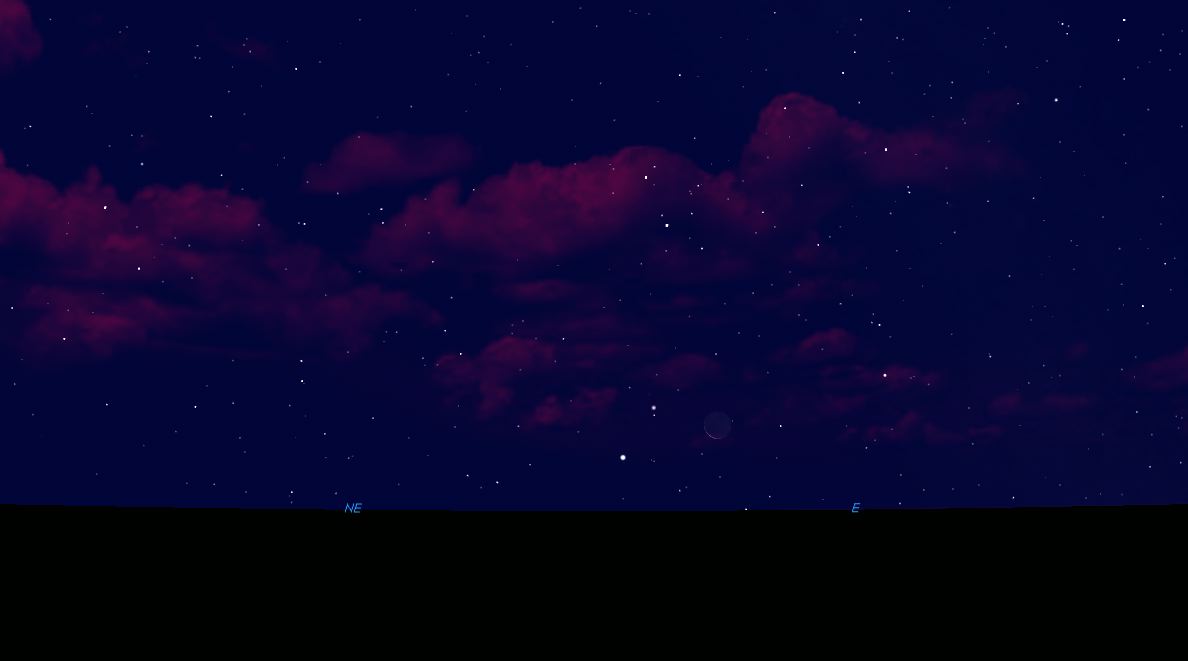
On August 23, 5:30 am, it will be the best time to see the conjunction of Venus, Jupiter, and the Moon. Here is an image of what it should like provided you have a clear view of the horizon. VJM conjunction Aug 23 2014

One week later, on August 31, at 9:20 pm, Saturn, Mars and the Moon will also meet up really close to each other. Here is an image of what it should like provided you have a clear view of the horizon. SMM Conjunction Aug 31, 2014

It is definitely worth viewing, especially if you can view the sun at the horizon. After I finished imaging the conjunction, I decided to pack up my scope and bring it inside. Once that was done, I decided to stay up and watch the sunrise.

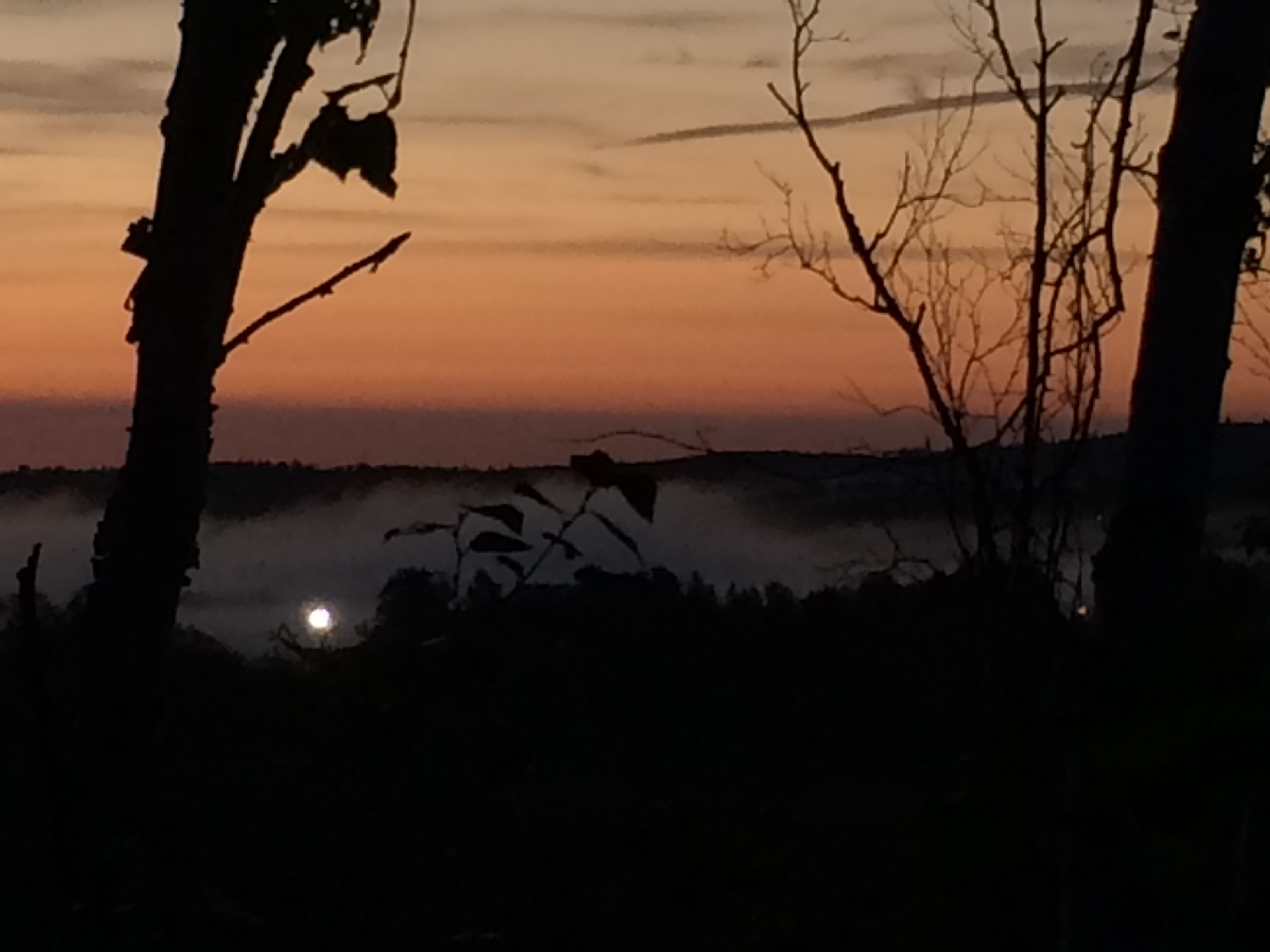
With a foldable chair in hand, I went to a small cliff near my house, where there was a clearer view of the conjunction, and the night sky. It was beautiful. The factories beyond the cliff were covered in fog, and the rest of the cliff had a stream of fog surrounding it. It felt surreal. I spent an hour there watching the fog come and go, watching the planets hide behind a brightening sky, and watching the sun rise. It was worth staying up to see. After watching the sun rise, I went back home and soon after went to bed.photo 2

photo 4photo 5It was a wonderful night. I was able to see the late night Moon, a mythical set of stars, and the close encounter of two notable and bright planets. As a bonus, I saw the sun rise above the horizon, and bring an end to the night. I encourage anyone that wants to try and observe these night sky objects and events to do so. If you have any questions for me, please let me know in the contact form at: https://jolyastronomy.com/contact-me/

Good Luck and Happy Observing!

The Orange Moon

During the night of August 7-8, I saw the moon in a way that is rarely seen. The moon was a bright orange-red colour in the night sky. At the same time, there were very little stars visible in the night sky, for some reason. It was quite perplexing why, but I decided to not worry about it and to focus on the Moon that night.

The Red Moon

The Red Moon


Many months ago, I was working on RASC’s (Royal Astronomical Society of Canada’s) Explore the Universe certificate program. My progress with the certificate stagnated for a while, and after realizing that I didn’t document when and with what I saw each celestial object with, I learned that I cannot use my current observations towards my certificate. Therefore, I had to start over again. It was heartbreaking to start again after working hard to find and observe those objects.

Despite that setback, I found a great opportunity to view this strange, yet beautiful moon. I quickly aligned my telescope to the Moon and I began looking at the features of the Moon. Last time I explored the Moon’s surface features, the moon was a waning crescent, which made it difficult to find all the surface features (mares, and craters) necessary. Here is a link to the previous blog post chronicling that night. During this night, the Moon was coming very close to its full phase, which meant that more surface features were visible and it would be easier to find them.

Since I had done this before, it was easy to find the mariae I found during my previous search, such as Oceanus Procellarum, Mare Insularum, and Mare Imbrium. I also found Crater Copernicus and the Crater Plato. After finding those mariae and craters, I went on to find other features that were in the dark side the last time I observed the Moon in its waning crescent phase. Here is an interactive map of the Moon to follow.

On the Moon, beside Mare Serenitatis is Mare Tranquilitatis, where Apollo 11 first touched down on the Moon. I then found Mare Crisium, which is located North-East of Mare Tranquilitatis. It quite perplexing how all the Mariae’s regolith contrasts with the regolith surrounding the mare. From my research, I learned that the formation of the Mariae started 3.9 Gyrs (Billion years) ago. At that time, the Moon’s crust had solidified and was being bombarded by many asteroids. Then there was a large volcanic event which flooded the plains with magma. It’s unclear why the mariae are concentrated in the near side but one theory suggests that the near side’s crust is thinner than the far sides, which made it easier for volcanoes to erupt at the near side. Another theory suggests that since the Earth and the Moon were closer to each other (10x closer) when they were formed, the hot Earth heated the near side, which delayed its cooling process. Whatever the reason, I’m glad humanity has the opportunity to see the mariae.

After finding many mariae, still not finding enough of the mariae on the list, I went back to Mare Imbrium to look for other mariae. I soon realized that north of the Plato crater there was Mare Frigoris, also known as the Sea of Cold. Looking at my list, I found the required number of mariae on the list for the certificate. I then moved onto finding the required numbers of craters.

It was considerably harder to find the craters on the Moon as most craters, unlike mariae, are not as recognizable, however, I was up to the task. After finding Crater Copernicus and Crater Plato, I found Crater Kepler, which was not on the list. I then found Crater Tycho, which looks similar to Crate Copernicus. In my previous attempt at looking at the Moon, Crater Tycho was hidden in the dark side of the terminator, which divided the Moon between the illuminated and the unilluminated side.

I then found Crater Aristarchus, which was also not on the list. After finding that crater, I was able to find three more craters to complete the requirements of my list. They are Craters Ptolemaeus, Aristoteles, and Posidonius. After finding Crater Posidonius, I finished most of the lunar requirements of my list. It felt great to finally start that certificate again.

Since the night sky was so hazy for some reason, I wasn’t see anything else, and as a result, I decided to pack up my equipment and bring it back to my house. It was a successful night of observing. I saw a beautiful red Moon, and identified many of its features. One thing that made today unique was the hazy red moon. After some research, I realized that the moon was red because of the smoke from the Northwest Territories Wildfires moving down towards Ontario. It was intriguing how events far away can effect us back home.

Happy Observing!