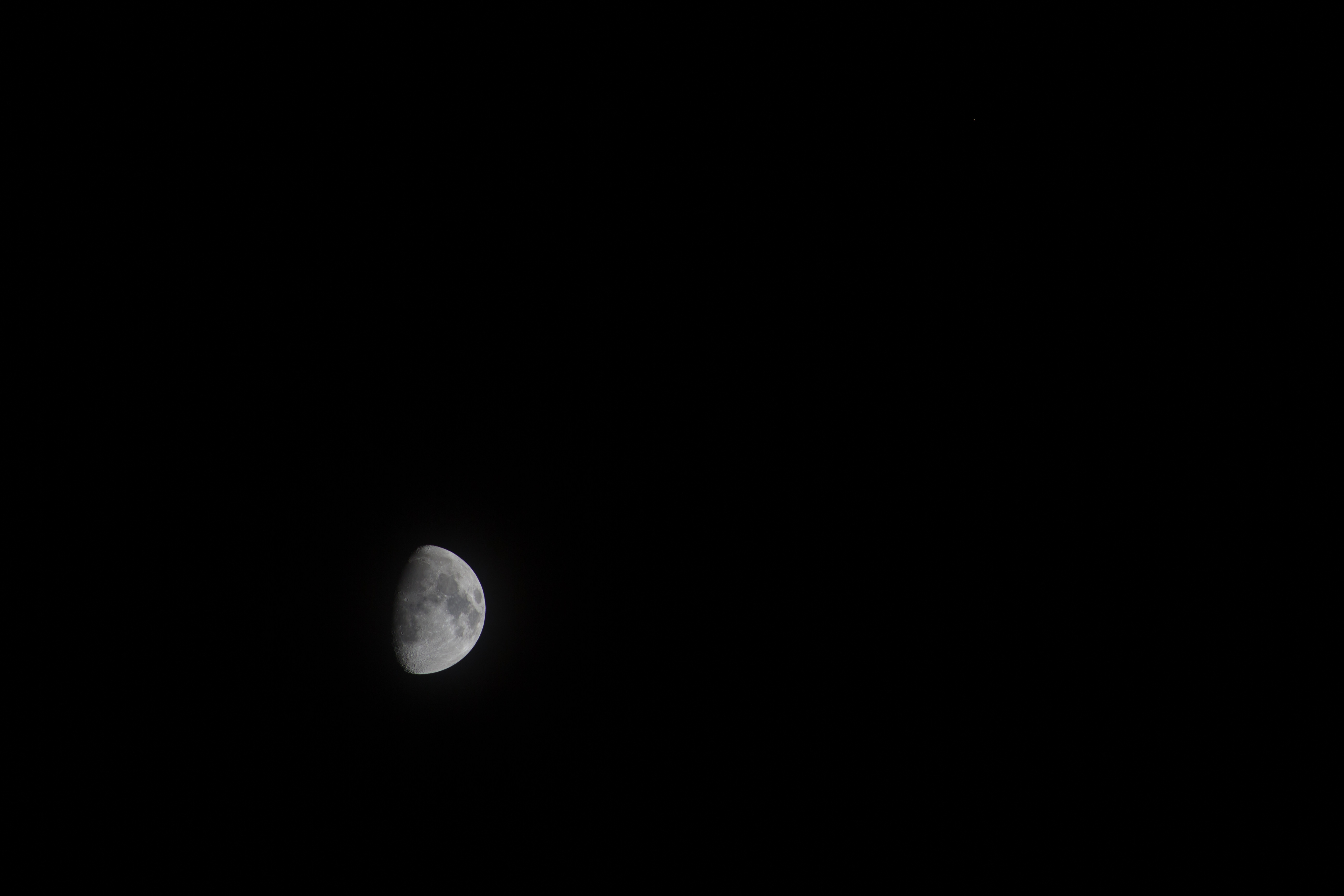
Astronomy with Araz

It was a semi-cloudy night on Friday, July 25, 2014. That night, I met my friend, Araz Boghossian, who is a photographer, electrical engineer, and amateur astronomer, in King City. Using his vehicle, we went to a lake near his house. Before we parked, a man that was there questioned why we were there at this location. We explained to him why we were there, and was all right with it.

We quickly unpacked all our equipment and got it assembled. It was a good location, but since it was near a lake, it was infested with large mosquitoes, hungry for human blood. I had a mosquito repellent clip-on, but it didn’t work (I later learned I didn’t set it up right.) There, I was able to use my new equipment, such as my new flip mirror, which allows me to connect two devices into my telescope, such as an eyepiece or a camera; and my DC adapter, which lets me connect the telescope to a car adapter to run the telescope off its power supply.

We did a lot of astronomy there. We first aimed at Mars. Since it is moving away from opposition, it didn’t give us much detail, and we quickly moved onto Saturn, swatting mosquitoes at the same time. Once we had Saturn in view, we had a look at the beautiful, ringed Saturn. When Araz saw Saturn, he was awestruck by its beauty. We kept looking at it, and we noticed three of its moons glowing dimly in the telescope. It was quite amazing and surprising that we were able to see three of its moons.

Using Araz’s camera, we decided to take a few pictures of Saturn. Araz, fighting the bugs around him, quickly got his Nikon DSLR camera, switched his lens with his T-ring so that he can put it in my telescope. Once it was firmly attached, I flipped the mirror. Initially, there was no image, however, we quickly realized that it wasn’t focused properly to the camera. The eyepiece and the camera require different focusing, which meant we couldn’t see using the eyepiece and the camera at the same time. Fortunately, we were able to get Saturn in view of the camera. Once Saturn was centered in the camera, we were able to take many photos. The first few were relatively blurry, but as we played with the focusing, the clarity improved. Eventually, we were able to get a great set of images of Saturn, which clearly showed the gap between the planet and the ring. It was beautiful.

After a good imaging session, we decided to move onto M51, a galaxy I have yet to find. After, unsuccessfully, trying to find it among a sea of stars, we decided to try taking some images of the night sky itself. Therefore, Araz removed his camera from my telescope, replaced the T-Ring with his 18 mm lens, and left the shutter open for a long time. He was able to take some star trail images, which meant that the camera wasn’t moving with the Earth’s rotation, as a result, it captured the movement of the stars in the night sky. He showed me the pictures, and the images were well captured. At the same time, I was still looking at Saturn, and it was still shining beautifully.

After his long exposure images, we decided to try and take a long exposure image on my telescope’s piggyback mount. We tried to take a picture of the Big Dipper, which didn’t turn out as we hoped. The image we took was more of a star trail image than an image of the Big Dipper. This meant that my telescope wasn’t properly tracking the night sky. I would need to get my telescope repaired.

After that, we decided to call it a night. We packed up our equipment and headed back home. It was a great night. The sky was clear enough to view the planets and the stars with. Waking up the next day, I was covered in mosquito bites. Nevertheless, it was a great experience. Hopefully, the next time Araz and I meet, we will have more targets to search for, and my equipment will finally begin to work better.

Until then, happy observing!

Star Party in the City

On Monday, June 9, 2014, the Royal Astronomical Society of Canada (RASC) hosted its monthly City Star Party. This star party took place at Bayview Village Park, where many RASC members came to view the Moon and the planets and any stars that were visible in the night sky.
IMG_7875

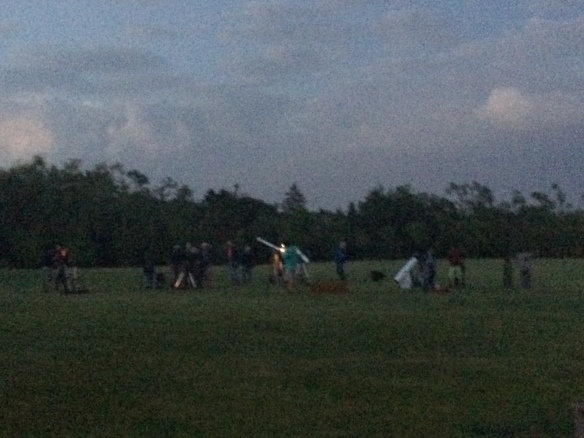
RASC Members setting up telescopes.

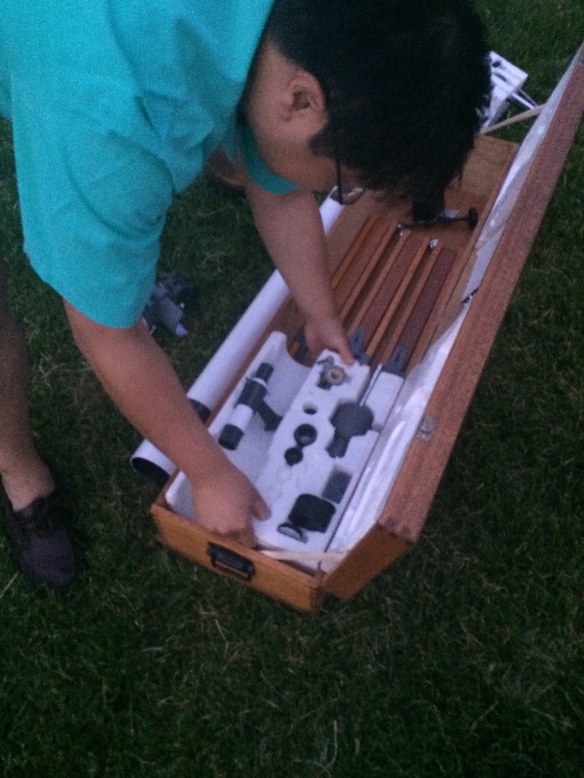
I arrived at Bayview Village Park at 9 pm. By then, many RASC members and visitors were setting up their telescopes. There were a few Schmidt-Cassegrain telescopes, a couple of Newtonian telescopes, some Dobsonian telescopes, and a fair amount of refractor telescopes. One member brought a refractor telescope that he restored using 60 year old optics handmade from Japan. It was quite amazing to see such an optic being used again after all these years. It was very interesting.
IMG_7857

A RASC Member setting up his newly restored telescope. Used with permission.

When I was there, it was quite cloudy. So much so that it casted doubt as to whether the sky would clear. However, half-an-hour later, it cleared up very nicely. We were lucky that we were blessed with a clear night to view the planets.

Once I saw that the sky has cleared, I decided to set up my telescope. It took a few minutes, but I got it up and running. While I was operating it, a few people came to my telescope and looked through it. I was able to answer any questions they had about astronomy and imaging the night sky.

Doing that, I was also talking to a friend of mine, who also has an interest in Astronomy. I told her about the city star party. At the same time, the International Space Station (ISS) appeared streaking across the night sky. It was very beautiful but not as bright as when I was in Glen Major Park during the May 24th meteor shower. Since I had my telescope, I decided to slew and try to capture the ISS on my telescope. It took a while, but I was able to see the ISS on my telescope zipping by very quickly in the field of view of the scope. From what I saw, I felt like I would be able to make out the shape of the ISS from the telescope. Wouldn’t that be a sight!
IMG_7894

ISS flying through the sky.

After viewing the ISS, I went on to view the planets and the Moon. I first slewed to Mars. Like all the other times I viewed Mars, the surface features weren’t clear to me. I then slewed to Saturn, and saw its majestic rings. A few people came to my telescope and checked out Saturn. They were awestruck by its beauty.

I then returned to Mars, but I wanted to zoom closer to it. I borrowed a friend of mine’s 10 mm eyepiece, which will zoom in further towards the planet. However, I had a lot of trouble finding it. One issue I am experiencing is that my finderscope’s base is quite wobbly. It made it hard to find any celestial objects, because the finderscope wasn’t calibrated to my scope for long. I decided to slew back to the moon and calibrate my scope there. After doing that, I slewed back to Mars, and using my friend’s 10 mm eyepiece, I finally found Mars. It was slightly bigger, but no more detailed than before. I soon returned his eyepiece, and continued to observe the night sky.

I then slewed to the Moon for another visitor, and a visitor was amazed by the beauty of the Moon. For the night, I felt like there was a lag on my telescope. I now know that there is a 1 second-long lag on my telescope. I suspect it is because of the Azimuth gear broke down again. It was confirmed by another RASC member, with the same type of scope, who recently joined RASC. As a result, after looking around a bit more, I decided to pack up my scope for the night.

I brought all my equipment to the car, and made sure I didn’t leave anything behind. After I packed everything up, I came back to look at other people’s telescopes. I saw a variety of objects. I saw Jupiter through my friend’s restored refractor. It did a good job magnifying Jupiter. It was beautiful.

IMG_7911

RASC City Star Party underway.

I then went to someone who had a circular telescope. It looked like a beaker. The owner told me it was an Astroscan telescope. Another RASC member came up and talked to the owner of the telescope. It was interesting to hear that this telescope was built in the 1970’s. Looking through it, when it was slewed to the Moon, it magnified it, but compared to my scope, the image was very small, but the quality was really good. I was impressed.

I soon went to another RASC member’s Meade Schmidt-Cassegrain Telescope (SCT). He had attached a binocular adapter to his telescope. He let me look into it, and I saw Saturn, but with both my eyes. With most scopes, you need to close one eye to see through the telescope. However, with the binocular adapter, you can use both eyes to see the night sky. It was interesting to use both eyes to view an object. It might be something worth investing in the future.

I then went to another RASC member’s telescope, and I was introduced to the Double Double, also know as Epsilon Lyrae. It is a multiple star system located in the Lyra constellation. We saw two binary star pairs in orbit with each other. This image of HD 98800 is a good approximation of what it looks like from an up close vantage point:

https://i0.wp.com/upload.wikimedia.org/wikipedia/commons/thumb/c/c7/HD_98800.jpg/750px-HD_98800.jpg

Artist depiction of HD 98800, a double star system.

When I saw that, I was intrigued by it. It is the first double star system I saw. Hopefully I will see more, and try to image them in the near future.

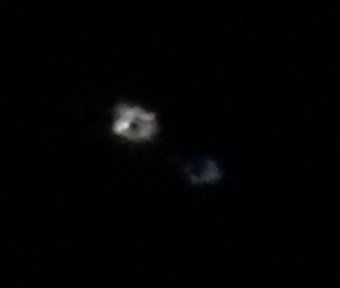
I then went to another telescope operated by another RASC member. He showed a group of listeners how you can visually tell the star’s temperature by slightly defocusing the image. It was quite interesting. Here is an image: (The blue star is hotter than the yellow star)
IMG_7917

Two stars that have been defocused. The lighter coloured star is cooler than the blue star.

It was very interesting to know that. This means I can look at the stars, and get a good idea of how hot a particular star is. Hopefully I can put it to good use.

I then went to another member’s refractor telescope that was pointed to the ring nebula. I was excited to see the ring nebula in its beauty. Earlier in my hobby, one RASC member told me that we shouldn’t expect much from Deep Sky Objects when observing them visually. I finally understand why. What I saw was the Ring Nebula, but it was barely visible. I was able to see a grey indentation of the ring nebula behind a black sky, but nothing more. I suspect light pollution played a big part in blocking a large portion of this Messier object. Hopefully I get a chance to look at the ring nebula in darker skies.

At that time, the ISS finished an orbit and came back up the night sky again, albeit at a lower elevation than before. It was really nice to see the ISS again. Unfortunately, I couldn’t image it again with my scope as it was packed away.

Near the end of the night, I saw a RASC member with a CGEM EdgeHD Celestron Telescope. It is the top of the line telescope, with excellent optics to view the night sky with. I was able to learn about polar alignment with their mount. There is a recticle there which shows a circle with a smaller circle at the edge of the bigger circle. You put Polaris inside the smaller circle and you get a good approximation of where the North Celestial Pole is. It was interesting to see how polar alignment works in the CGEM Mount. They then slewed to Mars. I hoped they would slew to Mars to test whether their scope has better detail of Mars than my own scope. Unfortunately, it didn’t look much different than my own scope. Maybe it is because of the seeing, or multiple frames need to be stacked before getting any detail. Whatever the reason, Mars is tricky to see and image properly. Before Mars goes behind the sun, I hope I can get a good image of it.

By midnight, many people left with only a few people still observing. I also decided to leave the party at that time, and head home. That Star Party had been a very interesting experience. I saw a lot of new and interesting celestial objects. I also learned a lot about telescopes, and how to use them better. I saw the ISS twice tonight, and I met a lot of new people. Hopefully, the sky for the Dark Sky Star Party is clear and the turnout is as much as the City Star party. Good night and happy observing!


WORKS CONSULTED

http://observing.skyhound.com/archives/jul/HR_7051.html

http://en.wikipedia.org/wiki/Epsilon_Lyrae


IMAGES USED

Attempt at Planetshine

On June 1, 2014, it was predicted to be a clear night. It was also predicted, by my Clear Sky Chart app, that the planets would be aligned just right so that you could see four of the five visible planets in the evening sky. Mercury would  be closest to setting, then Jupiter, then Mars, then Saturn. It would’ve made a nice image. Therefore I went to an elevated area to try and image it.


My telescope in the evening sky

My telescope in the evening sky

I had to go through various weeds to get to the right location. However, contrary to the Clear Sky Chart app, there were clouds in the sky blocking my view. It was disheartening to see those clouds in the sky despite a prediction of a clear sky. I stayed a bit to see if the clouds would clear, fighting off mosquitoes at the same time. However, it became apparent to me that the sky wouldn’t clear in time. I then tried to take a few four-minute exposure images of the Moon to get a few moonshine images, however, those images turned out to be a bit unclear and unfocused. That trip turned out to be quite a waste. However, I didn’t want to call it a night yet.

IMG_8586

The Moon at dusk

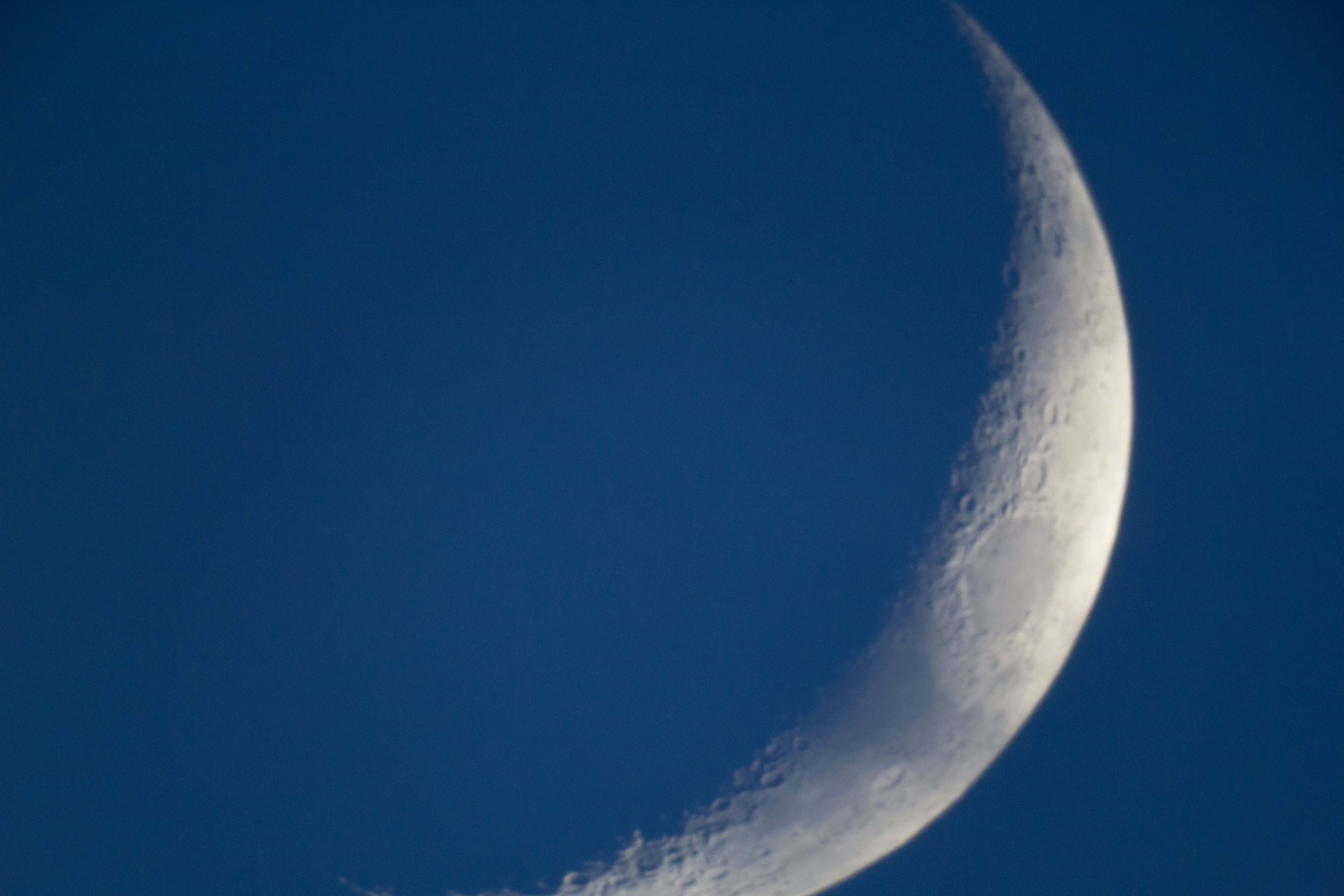
Later that night, the sky cleared up, and I decided to take a few long exposure images of the Moon to try and get the planetshine effect on the Moon. In a crescent Moon, the the majority of the Moon is dark, due to its position relative to the sun. However, it is not completely dark. If someone aimed a camera at the moon and collect enough light, one could see the darkened side of the Moon. That is because the Earth reflects sunlight as well. The light collected from reflected light from the Earth is called Planetshine or Earthshine in the case of Earth. It can make for a unique picture of the Moon. I was able to take a few pictures of the Moon with the Earthshine visible. However, I have yet to stack the images. Here are two image I took:

IMG_8595

Crescent Moon

IMG_8609

Earthshine visible on the Moon.


After I got those photoes, I decided to finally call it a night. I brought all my equipment inside and got some rest. While I have been taking potentially great photoes, I have yet to co-add them and see the final result. In order to move forward, I need to find an effective way to co-add images, convert RAW image files to TIFF or JPG files, and produce phenomenal images. Once I can master that, then I can move forward. I hope I can do that one day. Until then, I will keep doing what I do. Wish me luck!

Conjunctions and Neighbours

On June 7, 2014, Mars and the Moon were in conjunction with each other being only two degrees away from each other. According to my Clear Sky Charts app, it would be clear before 1 am, therefore I decided to quickly image the conjunction using a camera with a telephoto lens.

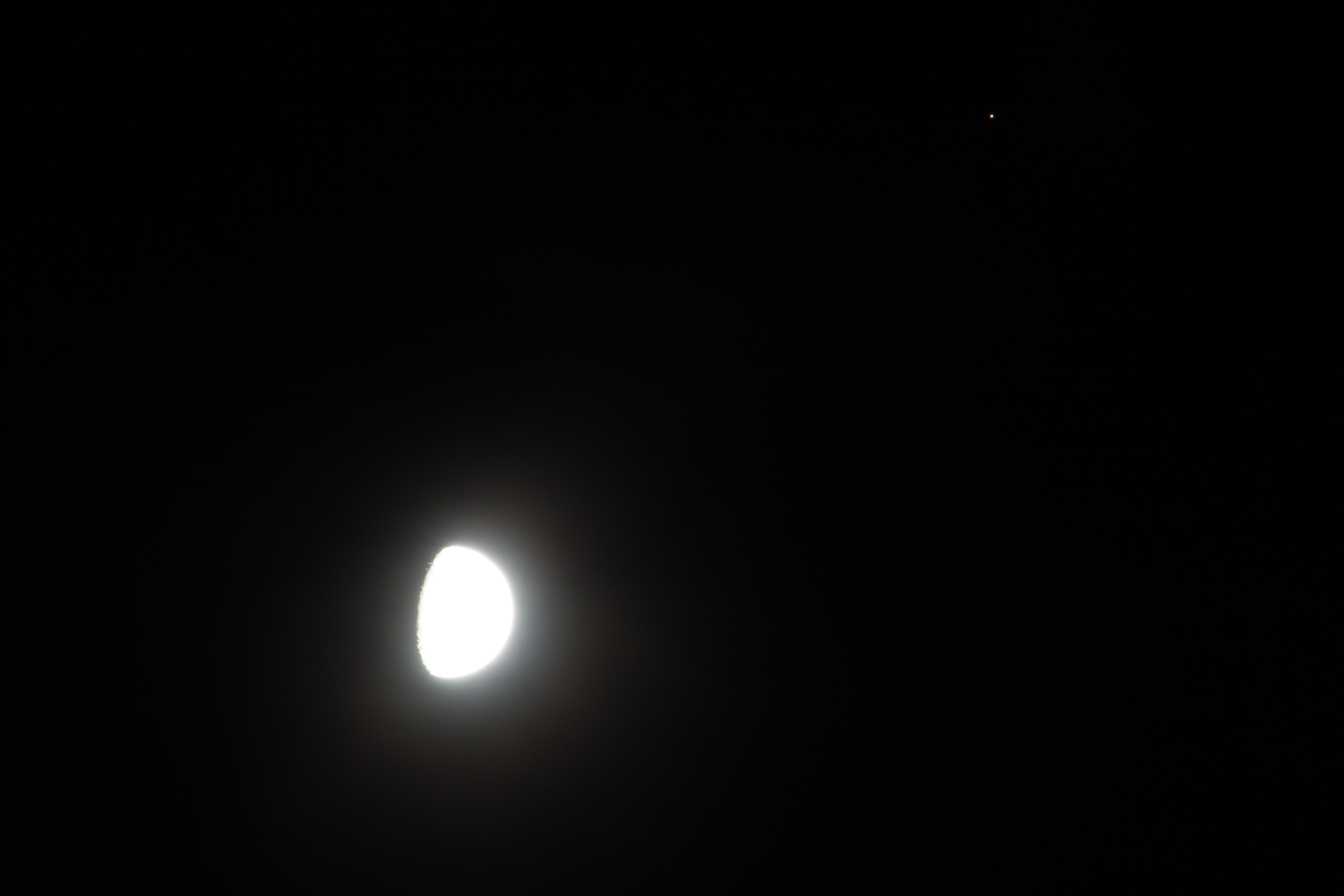
I was able to take a lot of images of the conjunction. There was light cloud cover, but it didn’t overtly obstruct the Moon and Mars. I used a variety of exposure settings, and sensitivity settings to try and get the best image. When I found a good set of settings for the image, I took a few frames and their corresponding dark frames to stack them later on. Here are a few pictures I took:

IMG_8629

Moon and Mars conjunction. They are two degrees apart from each other.


IMG_8637

The Moon. It was a split-second shot. The amount of light captured was enough to see the Moon only. Mars was too dim to be captured at that setting.

I set myself up on the driveway, which meant that I attracted the attention of many onlookers driving through the neighbourhood. It was nice that people had an interest in what I was doing. However, one of the most notable moments was when my next door neighbours noticed me looking into my telescope. Two of my neighbours noticed what I was doing, and approached me. I told them about tonight’s conjunction of the Moon and Mars, and what I was doing to image it. I let them look into my telescope to see the Moon and Mars for themselves. They were quite surprised at what they saw. They asked me many questions, relating to imaging these celestial objects, the telescope quality and price, the effects of doing astronomy in the city, and other questions. It was a great conversation. It felt good to show them what I do as an amateur astronomer. After a while, they went back inside. I continued to stay outside and image the sky.

IMG_8697

Mars and Moon conjunction. 30 second exposure.

However, I didn’t stay out much longer. As the night went by the cloud cover become more intense, actually blocking my view of Mars. When I couldn’t see Mars anymore, that is when I decided to pack up and go back inside.

It was a really good night. I saw the conjunction of two celestial objects and I showed what I do as an amateur astronomer to my neighbours. It felt good to do that. Hopefully, I can do it again the next clear night.

Family Night at the Observatory

On Saturday, May 31, 2014, the David Dunlap Observatory (DDO) hosted a family night where families could come and tour the DDO, learn about astronomy, and have a great time. As a member of RASC, I went to this event as a volunteer.

The DDO Big Dome

The event started at 9 pm. I was assigned to work at the DDO Big Dome with two other people. My assignment was to explain how the star finder worked, and what each image was on the wall. During the event, I was able to explain to visitors how the star finder worked, and talked to them about the exhibits that were on the observatory’s wall, and was able to answer any astronomy-related questions.

One of the most fulfilling moments during my time there was when I talked to a guest and the group of kids about what’s the best scope to use, and answered questions about the planets, movement of the stars, and other questions. It felt good to help them get interested in astronomy.

After the family night ended, the RASC members were invited to look at the planets with the big telescope. We saw Mars and Saturn using that scope. It was incredible to see planets on a telescope that has been used in a variety of research projects during its 79 year lifetime. Note that the images taken are not the same as when you actually look through it.

IMG_7478

Mars through the Big Scope


IMG_7495

Saturn through the Big Scope


After looking at the telescope, I decided to call it a night. Before I left, I looked at another RASC member’s telescope. It was a refactor with 330x zoom. Looking at Saturn, it was so close compared to my telescope. I was astounded by the zoom of his telescope.

IMG_7500

It was a great night, but it’s not going to be the only Family Night that RASC will host. RASC will host another one on June 14, 2014. Hopefully, you will all be there.

Sudbury Skies

On Sunday, May 18, 2014, during the Victoria Day long weekend, I was up in Sudbury with my family. We were blessed with beautiful night skies, and as a result my dad and I decided to take advantage of it and observe the night sky. We went outside to a clear area in our surroundings. After setting up the scope, it was ready to align.

We saw very unusual objects. There were fast moving objects in the sky moving as a group. We thought they were UFO’s at first, but we realized that they were birds flying across the sky. It was unusual to see these birds illuminated at night, even though Sudbury is a pretty dark place. However, due to the construction around the land, there were a lot of lights pointed towards the sky. Those lights illuminated the birds quite brightly, which led to that confusion. After clearing that up, we continued on with our astronomical goals.

We first aligned the telescope with Mars. Looking at Mars, it was a beautiful red dot that shined brightly in the sky. Unfortunately, we couldn’t make out any details on it. Looking at the sky, we also found Saturn and Jupiter in the sky. Saturn was moving upwards away from the horizon, and Jupiter was moving towards the horizon. From the locations of Jupiter, Saturn and Mars, I drew a line between them to see where the ecliptic was. The ecliptic is the path the sun takes when it rises and sets every day. I was able to estimate the location of the ecliptic, because all the planets orbit close to the plane of the sun, thus we see the rising and setting of planets near the same location as the ecliptic. It is quite interesting. After realizing that, we soon decided to slew to Saturn.

After slewing to Saturn we saw a brilliant planet surrounded with beautiful rings. It was a sight to see, especially up in the Sudbury sky. Looking around for another target, we saw a star that was flickering in the atmosphere between different colours. It was intriguing to my dad and me. I thought it was a variable star. However, my dad believed it was a star that was so low in the atmosphere that the atmosphere was dispersing the light. I’m not certain, but it could be it. We slewed to it and saw the fluttering star. However, at midnight, the clouds started to come in and block the starlight. With that, we decided to pack the telescope back into the truck and return inside.

Back in Action

I had telescope troubles earlier this year. As a result, I was out of commission for a large part of the year. Earlier, this week, my dad was able to resolve one of those troubles, and On Friday, May 16, 2014, I took the newly resolved telescope on a test run.

Once I brought everything out, I decided to align my telescope to Mars. My biggest worry in the repairs is that the tracking ability of my telescope would not work. After aligning it to Mars, I left it pointed at Mars for a while. When I returned to Mars, it hadn’t drifted from its position. This is a good sign that tracking is still working in the fixed scope.

After checking it a few times, it had drifted but not enough that tracking failed completely. I was happy with the results I was seeing. To see if tracking works away from the alignment object, I slewed my telescope to a random star. Leaving it for a while, the star did drift, but not far enough to conclude that tracking is not working. As far as I am concerned, tracking was working. I was really happy with the results I was seeing.

My next test took place in the opposite part of the sky. There was a dim star in the Western part of the sky, which I pointed my scope at. I looked at it for a while. I had to readjust my scope a couple of times, but it didn’t drift fast enough to conclude that tracking was failing. I was really impressed with the great job my dad did in resolving the issues in my telescope.

Lastly, aligned to Mars, I decided to point my scope at Saturn. There, it drifted a great distance, which concerned me. If it didn’t track with Saturn, then what is the problem? Has the gear burnt out? Has the software failed? Luckily, there was no problem. Saturn was able to stay inside the field of view of my telescope for a long time after readjusting it back to the center of my field of view. This confirmed the results that I had received, that my telescope troubles were over at last.

Happy with the results of my test run, I decided to pack up my telescope, and bring it inside. However, I wasn’t done. Before packing, I saw the rising of the moon through dense trees. This gave me the idea of watching the Moon rise. Therefore, after packing up and bringing all my equipment inside, I decided to head to a dark spot where the moon can be easily observed. Sadly, the moon had already risen, but it was no less beautiful. With my tripod and camera, I was able to compose a number of images of the scene with the moon in the background. It was very nice. A short while later, when it started to get too cold. I packed up and headed home. I was very happy with the results of that night, and with my telescope troubles officially over, I can continue to observe and image in the near future.


Sunspots and Solar Flares

On Tuesday, May 5, 2014, as part of astronomy week, the Royal Astronomical Society of Canada (RASC) hosted a solar observation event at the Ontario Science Centre. I was able to attend this event and observe the sun with a variety of telescopes. Most telescopes are using Baader film, which makes the sun look white, and hides the solar flare and prominences, but clearly shows the sunspots on the sun.

Another telescope called the Coronado PST uses a hydrogen-alpha filter. All the light, except the hydrogen-alpha light are filtered out and the sun glows red. The image projected shows the sun, but the sunspots are unclear. However, the solar flares and prominences are visible.

Looking at the sun using those telescopes was very intriguing. In my previous blog post, I talked about how the magnetic field of the sun works to form sunspots, prominences, and other solar activity. Going to RASC’s solar observing event gave me the opportunity to observe what I wrote about. I was able to see the sunspots. They were close enough to look like an arc was there. On the Coronado PST, there was a prominence or a flare visible from the top right of the image. It was an amazing feeling to see the sun so alive and so active.

The Sun through Hydrogen-alpha filter via Coronado PST.

I encourage anyone living in Toronto to come to the Royal Astronomical Society of Canada`s events. You can go to their website at: rascto.ca

To learn about solar activity, go to: https://jolyastronomy.com/2014/05/05/magnetic-fields-from-the-sun/


The Tetrad of Lunar Eclipses

Taking a break from magnetic fields, I wanted to talk about a very rare event that started taking place on Tuesday, April 15, 2014. The first of four lunar eclipses took place that night. This is a rare event as this tetrad of eclipses will occur six months apart from each other; the first one on April 15, 2014, the next on October 8, 2014, the third on April 4, 2015, and the last one on September 28, 2015. All of the eclipses will be visible from North America.

All these eclipses will be total eclipses. That is when the entire moon is completely engulfed in the Earth’s shadow. This is the most spectacular eclipse as the whole moon turns a bright red, reminiscent of a sunset. This is also called the blood moon. The next kind of eclipse is a partial eclipse. This is when the Moon crosses into the Earth’s umbra, but is not completely consumed by it. The last and least noticeable is a prenumbral eclipse. The Moon enters the Earth’s prenumbra, but doesn’t cross into the umbra. This is a very subtle eclipse. The most one will notice is a drop in brightness. Luckily for us, all the eclipses during this tetrad of eclipses will make the moon glow red. But why red?

That is because, when the sun obstructs the Earth, most of the light is being blocked, but the light hitting the atmosphere is bending towards the Moon. While that occurs, the atmosphere is also scattering the shorter wavelengths of the spectrum into the atmosphere, leaving behind the red wavelength, which is the longest and the least likely to scatter. This is why the moon looks red during a lunar eclipse, and this is why sunsets are red.

Unlike a solar eclipse, this eclipse is safe to view without any eye protection, and it is visible across a whole continent, whereas solar eclipses are visible in a thin, 250 km region during its path. That will be another post…

Thank You for reading.


WORKS CITED

http://www.cbc.ca/news/technology/total-lunar-eclipse-last-night-was-the-1st-of-4-1.2610637

http://science.nasa.gov/science-news/science-at-nasa/2014/27mar_tetrad/

A Red Moon – NOT a Sign of the Apocalypse!

http://news.nationalgeographic.com/news/2014/04/140410-lunar-eclipse-blood-moon-space-viewing-guide/


WORKS CONSULTED

http://www.answersingenesis.org/articles/2013/07/12/lunar-eclipses-cause-blood-moons

http://americanlivewire.com/2014-04-14-why-does-the-moon-change-colors/


The Search for M51

Friday, March 14, 2014 was clear despite a weather forecast of overcast skies. With that in mind, I decided to take my telescope out to observe the night sky and confirm what I saw last session was M51.

At midnight, I took all my equipment outside and I set my telescope up for observation. However, when I turned the mount on, it gave me errors 16 and 17. Both altitude and azimuth motors were unresponsive. I realized that the software thinks the mount is the GPS model instead of the SE model. This caused a conflict which caused me to take everything back inside. Once all my equipment was safe, I brought my mount to the computer to update the software. After updating the software to the correct model, I brought everything back outside and continued setting up.

Earlier that day, I was able to move the finderscope from its current position and screwed it in the same location of the piggy back mount. However, when I was calibrating the finderscope, the knob wouldn’t turn all the way to the target body (the Moon). Therefore, I decided to get the telrad (a superior finderscope) and tape it onto the telescope. I then calibrated it to the Moon.

When my telescope was pointed on the Moon, I realized that my neighbour’s house was starting to obstruct the Moon. At the same time, I realized that Mars was clearly visible from my position. I decided to slew to Mars’ position and I saw a beautiful red dot. However, I could not make out any detail. It’s still moving towards opposition, therefore it will get bigger, and hopefully clearer.

I decided to switch my eyepiece from 25 mm to 20 mm to get more magnification and get closer to the planet. After switching the eyepieces, it was out of position. However, I was able to find Mars again. It was slightly bigger in this lens than in the previous lens. It was great to get closer to the planet. After staring at the beauty of Mars for some time, I decided to search for M51.

I moved my telescope to an area where the stars near zenith were not obstructed by trees. I scanned at the same part of the sky where I first saw it, but I didn’t find anything. I found its RA/Dec Coordinates, and slewed my telescope to the coordinates using its computer, but the telescope slewed to the wrong area. I tried slewing to its approximate alt/az coordinates using the SkyView App on my iPhone, and slewing to those coordinates using the computer. However, that didn’t work out either. I was becoming frustrated. Eventually, the clouds moved in, and I had to pack up.

I solved a lot of issues this session, such as my mount, and my finderscope. In addition, I also found Mars. It was an incredible sight. The last time I saw Mars was at 5 am in the park. I hope to see it again, preferably at opposition, when it will look big. Sadly, I could not find M51. However, in retrospect, I realized that moving the teIescope caused my failure to find M51, because the telescope didn’t know that it moved from its current position. That is the reason why my telescope failed to find M51. I hope to prevent that in the future.

Clear Skies to you all!