Unknown's avatar

About Chris Joly

I am an Armenian-Canadian student. I am an amateur astronomer, amateur photographer, home winemaker, and writer. My goal is to write about my experiences, and anything of significance and to share it with the world. I hope you all enjoy what I write.

The Orion Nebula

Hi everyone,

In my previous blog post, I had my heart set on going back out in the bitter -16 C cold to image the Orion Nebula, and I did just that.

I took my telescope to the backyard, where I could get a good view of the constellation Orion. After aligning my telescope to Jupiter, I slewed to the stars that represent Orion’s sword. Looking for the green cloud, I saw all of Orion’s stars again in its unique locations and patterns. It was quite a sight to see.

Eventually I was able to find the faint green cloud I found in a previous astronomy session, and I took a series of long exposure photographs of the Orion Nebula with an ISO of 1600. Unfortunately, It wasn’t properly focused, and I had trouble focusing my telescope. I was only able to get one “good” photo of the Orion Nebula. It’s not that focused, but I did my best.

Image

The Orion Nebula. Forgive me, the image is blurry.

After taking a few more long exposure images that were not successful, I decided to call it a night, and go back inside. I brought the eyepiece and camera indoors first, and then the telescope, making sure to use gloves instead of my bare hands. Once indoors, I put all telescopic equipment in its right place, and then warmed up by the fire again.

These two sessions were quite productive. I got my first taste of DSLR astrophotography by taking a two second exposure image of the moon capturing the Old Moon in the New Moon’s Cradle phenomenon. I was able to see Jupiter at close to opposition, despite my failure to image it, and I got my first image of the Orion Nebula. While it is clear I need to work on my astrophotographic skills, I have taken my first steps into it.

Tomorrow will be an early day, for there is another session in the morning. Stay Tuned.

The Old Moon in the New Moon’s Cradle

Hi everyone,

Happy New Year to everyone and Merry Armenian Christmas (January 6th) to all my Armenian friends.

On January 3rd, as the sun set, I noticed in the navy blue sky, that a thin crescent moon was visible in the sky. Therefore, I decided to take my telescope out and take images of the moon.

For Christmas, I got nice additions to my telescope: a new T-Ring and T-adapter for use with DSLR cameras. Therefore, I decided to take the photos using my brother’s DSLR camera, which was a Canon EOS D60.

I took my telescope out in the bitter cold night at -16 degrees celsus, and quickly got it set up aligning it to the crescent moon. Looking at the crescent moon, I saw a small portion of a mare, and many craters on the lower part of the crescent. It was beautiful. Since I was using a DSLR camera, I could take long exposure images, which I could not do using my CCD imager. With that feature, I have the ability to obtain different kinds of pictures of the different bodies of the solar system. I quickly went about taking the photo.

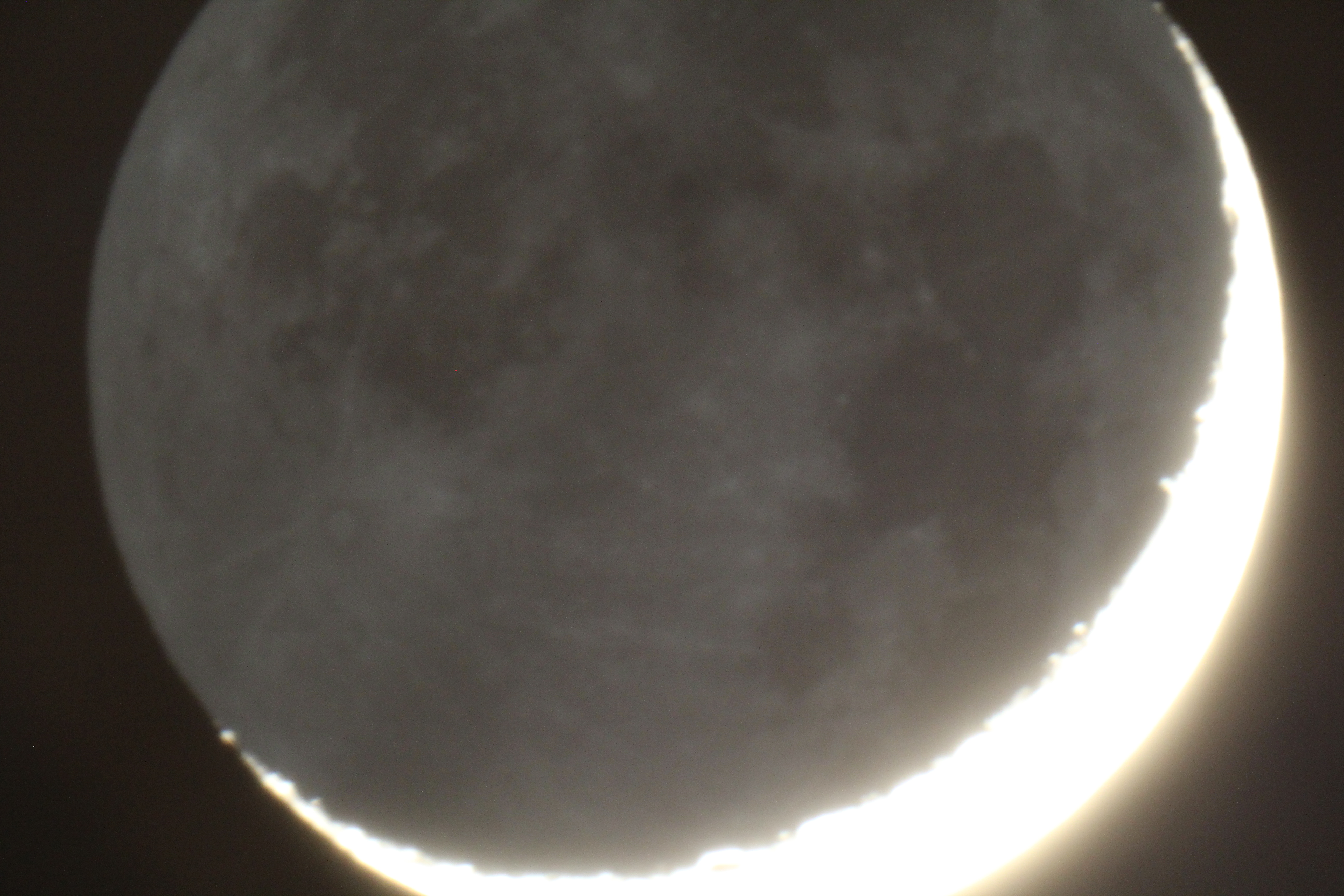
I experimented with the exposure setting, and tried to figure out how to eliminate the wobble that I created by pressing the shutter button. Eventually, I found the right setting for the image and captured a fair number of images of the moon. The moon captured in my images were two second exposure photos with the other settings set to auto. It showed the lit portion of the moon completely white due to the collection of light from the moon, and the dark portion dimly lit. The reason that happened is because the Earth also reflects the sunlight that it receives from the Sun. The reflected sunlight travels to all different directions, and a certain amount of the sunlight hits the moon. This phenomenon is called Planetshine, and it creates this photographic phenomenon called, “The Old Moon in the New Moon’s Cradle.” It is a unique sight for those who know how to find and capture it.

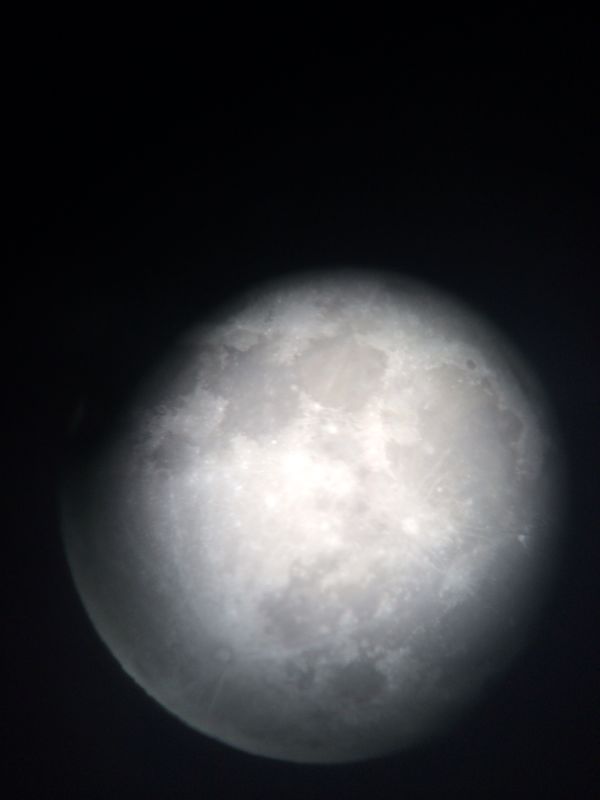
Below is a comparison of the crescent moon and the Old Moon in the New Moon’s Cradle.

Image

The Crescent Moon

Image

The Old Moon in the New Moon’s Cradle

After the Moon set below a row of houses, out of my sight, I decided to focus my attention on Jupiter. It would be reaching opposition the next day, which means it would begin moving backwards relative to the Celestial Sphere, it orbits closest to the Earth, which makes it seem closer than it actually is, and it is visible all night, much like a Full Moon. Since the next day was predicted to be cloudy, I decided to look at it now.

Looking at Jupiter through the DSLR camera was a different (no, difficult!) experience than through the eye piece. Jupiter looked quite over-exposed. Any attempt to take a long exposure image of Jupiter failed as the camera wobbled too much and my telescope tracking feature was not doing a good job at keeping the image still. I didn’t have enough technique to take a good image at that time.

As a result, I decided to pack it in for the night. I took all my equipment inside and got warm by the fire. It would usually be over for the night, but the sky was still clear, and I felt the need to take my telescope out once more. Therefore, I did just that.

Stay tuned for the rest of this blog post.

WORKS CONSULTED

http://en.wikipedia.org/wiki/Opposition_%28planets%29

http://en.wikipedia.org/wiki/Planetshine

A Cold Christmas Night

Last night, three days after the Toronto Ice Storm, Santa brought us astronomers a Christmas gift: Clear Skies! Therefore, I decided to take advantage of it.

My goal for this session was to view a rare astronomical event: the occulation (blockage) of a star by an asteroid. The star was a 10.4 magnitude star (not very bright). The asteroid was a 15.4 magnitude asteroid (dimmer than the star). To see it is a slim to nil chance, but I tried.

At 10:50 pm, I took my telescope out in the bitter cold and got it ready to view the stars in the snow. For the first time, I was able to align the telescope using the SkyAlign feature. In previous sessions, I failed to align the telescope using the SkyAlign feature. Yesterday, I succeeded in that. After aligning the telescope, I got the coordinates for the star in Ra/Dec and Alt/Az coordinates. When the telescope slewed to it, it was behind the trees. I had to readjust the telescope to view it away from the trees. When it came time, I looked into the telescope and I saw small stars. However, I don’t think I saw the star that was to be occulted. It was disappointing, but I wasn’t surprised. I was not prepared or experienced enough to find such a small and unknown object. I decided to move on to other objects on my list.

I first slewed to the bright object in the sky, Jupiter. I saw the beautiful stripes, and its 4 beautiful moons. It’s always a sight to see Jupiter. I can check it off my list now.

The next object I saw is Sirius. One fact about Sirius is that it is a double star system, with a star 2 times the size of the sun, and a white dwarf that already died. Looking at it myself, I saw the star, and I think I saw a bulge from one side of the star, which is probably Sirius B. I can’t be sure until I view it closer. I can now cross the constellation Canis Major off my list.

The next objects I observed are the two brightest stars of Orion: Betelgeuse, and Rigel. I first slewed to Betelgeuse, the bright red supergiant. It was magnificent. I next slewed to Rigel. I had to move my telescope a bit, but I was able to find it. It wasn’t as bright as Betelgeuse though. I was able to cross of Orion off my list of constellations.

I looked into the sky and saw a small cluster of stars, and I saw M45 also known as the Pleades, or the Seven Sisters. It is a star cluster that is visible to the naked eye, and is made up of 7 stars. I decided to  look at it through the telescope. Doing that, I saw the magnificence of the 7 sisters in its formation. It was awe-inspiring. I crossed it off my list under the Deep Sky Objects Category.

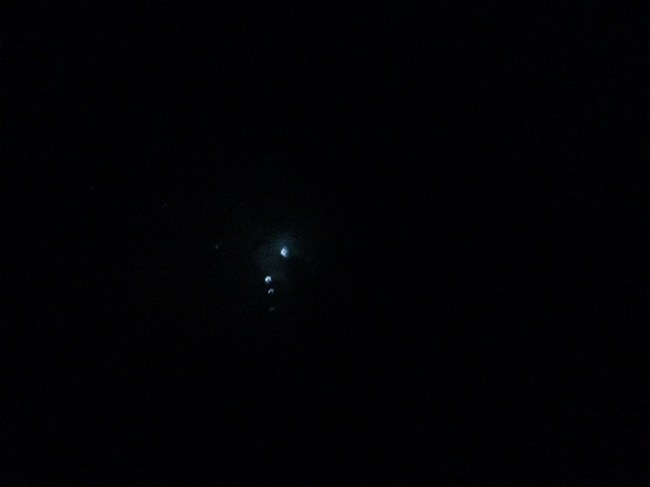
Remembering my previous session where I could not see the horsehead nebula due to the battery dying on my telescope, I decided to slew towards Orion’s sword, a collection of three stars that represent the sword of the mythological hunter, Orion. The vicinity of those stars are quite interesting. I see dim stars close together and in interesting patterns that one can’t see without a telescope. The most notable one that I saw was at the middle star. There I saw a dim green-tinted cloud of sorts in the sky. I have never seen that before, but I learned about it in the first few lecture videos in my Astronomy class. I believe I saw M42, otherwise known as the Orion Nebula. This was my first sighting of a nebula. I was very excited, and will explore further in the future.
Image

The Orion Nebula through my telescope imaged using an iPhone 5s.

Continuing my journey, my telescope started to become sluggish and unresponsive, which lead me to conclude that the batteries died once more. With that, I decided to call it a day… but not before manually moving my telescope to the rising Waning Gibbous Moon through the trees. It was a very nice sight and another addition to my list.

After that, I packed up my telescope and decided to call it a night.

Overall, it was a very eye-opening experience. I tried to find a unique star event, however, I failed to find it. I was able to observe Jupiter, Sirius, Betelgeuse, Rigel, The Pleiades, the Orion Nebula, and the Waning Gibbous Moon. It was truly an interesting and productive night, which took me a step further in my astronomy adventure. I hope you will come with me.

WORK CONSULTED

http://en.wikipedia.org/wiki/Sirius

http://en.wikipedia.org/wiki/Pleiades

http://en.wikipedia.org/wiki/Orion_%28constellation%29

http://en.wikipedia.org/wiki/Betelgeuse

Full Moon

Hi Everyone,

Before reporting my latest observational session, I would like to announce that I will be attempting to obtain a “Explore the Universe” Observing Certificate offered by the Royal Astronomical Society of Canada (RASC). The website of the program is: http://www.rasc.ca/explore-universe Wish me luck in my quest to see the stars.

On December 15, 2013, the night sky was graced with a full moon. This one was unusual, because it was not only the last full moon of 2013, but the smallest. That’s because the Moon was at its farthest, or at its apogee, at the time. As a result, it looked smaller than the average full moon. Luckily, the sky was clear at that time. I decided to take my telescope out to view the smallest full moon. It was a really cold night, however there was not a cloud in sight. After the telescope was set up, straight away, I slewed my telescope to the Moon. After getting it in focus, I saw a beautiful full moon with all its mares (grey sea) and mountains. It was beautiful!

Smallest Full Moon

After looking at the moon, I decided to turn my telescope to the constellation Cassiopeia; more specifically,  the star “Schedar”. Looking at the constellation Cassiopeia was part of the requirements to obtain that certificate I mentioned above. It was a bit difficult to find Schedar due to the light pollution in Markham at the time, however, as I was slewing the telescope I couldn’t help but notice a lot more dimmer and farther stars that could not be seen unless with a telescope. It astonishes me how so many stars exist, yet we see only the brightest stars in the sky in places like Markham, let alone Toronto. It was an intriguing sight!

Eventually, I found Schedar. Looking at that star, it was a bright ball of light that outshined all the other stars in its vicinity. A rule I set for myself is to observe the brightest stars before checking off the constellation for my program. As a result, seeing that star allowed me to check Cassiopeia off my list.

After viewing Cassiopeia, I was thinking about whether to call it a night, or continue. After looking at Orion, I remembered how one of the stars was close to the Horsehead Nebula. Therefore, I decided to observe it. Unfortunately, the telescope was not slewing. Pressing the buttons to slew the telescope only nudged it instead. Turning it off for a small amount of time allowed the slewing function to work again, if only for a short time. This led me to conclude that the batteries had died. Having no replacement batteries, I decided to call it a night.

During my December 15, 2013 session outdoors, I observed the full moon at apogee and I observed the star, Schedar, in the constellation, Cassiopeia. It was a good start on my list of objects to observe. Two down, fifty-three more to go.

WORKS CONSULTED

http://www.washingtonpost.com/blogs/capital-weather-gang/wp/2013/12/16/tonights-cold-full-moon-is-2013s-last-and-smallest/

Welcome to Joly Astronomy

Hi Everyone, My name is Chris Joly. I am an Armenian-Canadian student currently living in Toronto, Canada. I am an avid amateur astronomer. Ever since 2011, I had an intrigue in astronomy, and I have developed that hobby to the point where I am taking pictures of these celestial bodies using my Neximage Solar System Imager 5 camera attached to my Celestron Nexstar 8 SE telescope. Using my telescope and camera, I hope to continue taking images of the amazing planets, nebulae, stars, and other celestial objects in the sky and to share it with all of you.

The frequency of posts depend on a variety of factors, such as weather, whether I go on a viewing session, and other factors. However, when I do go out on an astronomy session, I’ll be sure to post it up for you all to read about.

Thank You for joining me on this adventure.

I hope you all enjoy what is written on this website.