Magnetic Fields: On Other Planets

Hi everybody,

We ended the previous post with mentioning that Earth is not the only planet with a magnetic field. All the planets, with the exception of Venus and Mars, produce magnetic fields.

Mercury, the closest planet to the sun, and one of the smallest planets in the solar system, has a magnetic field. It is thought that Mercury’s large core is doing the geodynamo process to produce the magnetic field, however, it has not been confirmed yet, and there are other ideas floating around. Mercury’s magnetic fields are only 1% the strength of the Earth’s, however, it is strong enough to repel solar flares. Currently, the MESSENGER probe orbiting mercury is working to learn more about Mercury’s magnetic field using a variety of instruments. Of the inner planets, Venus and Mars are the only planets that do not produce magnetic fields.

Mercury’s magnetic fields with MESSENGER’s orbit.

Venus is similar to Earth in some ways; however, it doesn’t produce a magnetic field. While our knowledge of Venus is incomplete, there are a few conjectures as to why that is. The first one is that the core has solidified and there is no convective outer core to convect any conductive fluids, and thus no magnetic field could be produced. Another conjecture is that, since the planet went through a major resurfacing event, the crust has effectively sealed the core in, and the core became heated to a uniform temperature which doesn’t promote convection. Another theory is that in addition to the lack of convection, Venus is also rotating so slowly (243 days/Venus Day)- it isn’t moving fast enough to produce any magnetic fields. Since Venus doesn’t have a magnetic field, and any solar flare will interact with the ionosphere directly, the ionosphere will slow the flare down and redirect the flow of charged particles. Since the atmosphere is dense, and Venus’ winds are intense, the ionosphere will prevent the charged particles from reaching its surface. Despite all we have learned about Venus, these theories are still conjecture, and it will be difficult to find answers due to Venus’ harsh conditions. We have more complete information about Mars, however.

Venus’, Earth’s, and Mars’ interactions with Solar Flares


Mars is different, in many ways, from Venus and Earth, but like Venus, it doesn’t have a magnetic field. It has an ionosphere present, but the atmosphere is quite weak; therefore, the planet isn’t protected by any solar flares. Its mantle is presumed to be inactive, and its core is already small, having never accumulated enough iron, therefore convection in the core stopped and the magnetic field ceased to exist. However, there are traces of a magnetic field in Mars’ past found frozen into the rocks on Mars that are over 4 billion years old. There is a theory that Mars’ magnetic field was destroyed when a large asteroid impact interrupted the convective process of Mars, which stopped the production of the magnetic field. It is under debate, though, as some might consider that Mars’ geodynamo process ended when the core cooled enough to stop the convection process on its own. It makes sense since Mars is smaller, and lighter. It would take a shorter amount of time to cool down than Earth would. Since the magnetic field ceases to exist, the solar flares were able to strip away Mars’ outer atmosphere and kill any life on Mars. Unlike some inner planets, all the outer planets have magnetic fields.

Outer Planets


The magnetic fields of the outer planets

All the gas giants have magnetic fields, with Jupiter having the strongest magnetic fields of them all. The magnetic field works much like Earth’s, with the geodynamo process originating from its metallic hydrogen outer core and its fast rotation period. However, it is 100 times larger and extends 20,000 greater than Earth’s magnetic field. Some say that the tail of the magnetic field extends as far as the orbit of Saturn. It’s so big that it begins to repel a solar flare 3 million kilometres away from Jupiter. However, because of its larger distance from the sun, the intensity of the solar wind is 4% that of the Earth’s. This means, less effort is needed to repel it. Much like Earth, Jupiter has a set of radiation belts that trap any charged particles heading towards it. It is 1000 times stronger than Earth’s radiation belts. In addition, the magnetic fields also receive particles from its innermost moon, Io. The sulphur, and oxygen Io emits from its volcanoes create a ring of gas that interacts with the magnetic field and collects it, which creates a gas torus. Spacecraft visiting Jupiter will need to overcome the intense radiation present in its magnetic fields.

Saturn’s magnetic field is the second largest in the whole solar system. It works a lot like Jupiter’s, but it is only half of its strength. This is because; the metallic hydrogen outer core that conducts the geodynamo process is smaller than Jupiter’s. When the magnetic fields interact with the solar flare, they interact from 20 Saturn radii away, and its tail extend much farther than that. The magnetosphere has many taurii, originating from Enceladus, and Titan. Enceladus ejects a large amount of water vapour into space. The water vapour ionizes and rotates with the magnetic field. Eventually, it escapes through the magnetotail. Titan has a large amount of Nitrogen ion plasma and is released into Saturn’s inner magnetic fields. There might be other sources inside Saturn’s rings, inner moons, or the upper atmosphere. When the solar flare hits Saturn, much like Earth, aurorae are formed on Saturn spanning the whole spectrum of light. Spacecraft visiting here have to overcome its intense radiation as well here.

Uranus’ magnetic field is 0.1 times that of Saturn. Before Voyager 2 arrived there, no experiments took place there of its magnetic fields. They expected a magnetic field similar to the ones they knew, such as Earth’s. However, measurements revealed two major differences: Uranus’ magnetic fields aren’t in line with the center of the planet, and that it is tilted 59 degrees from the rotational axis. This means the magnetic field produced is asymmetric across the whole planet. One theory to suggest why it occurs is that, unlike the other planets where the magnetic fields are generated in their cores, Uranus’ magnetic fields is formed closer to the surface, such as in a water-ammonia ocean, where convective movement could take place. Since the magnetic axis is highly inclined with respect to the rotational axis, the magnetotail would be wound into a corkscrew shape. In addition, the radiation belts are mostly made of Hydrogen ions, which suggest that there are no taurii present from any of its moons. However, despite its differences, its magnetic fields are similar to Saturn’s magnetic fields.

Uranus and Neptune’s magnetic fields

Neptune is very similar to Uranus and is the only other planet to have similar magnetic fields to Uranus. Its magnetic field is titled relative to the rotational axis by 47 degrees and offset by 0.55 Neptune Radii. Comparing it to Uranus, it is likely that there is convective flow in a shell of conductive liquids that drives the geodynamo process. When the solar wind interact with Neptune’s magnetic fields, it starts to repel it at 34.9 Neptune Radii, and the magnetotail extends at least 72 Neptune radii, and probably farther. In addition, it is found that there are aurorae on Neptune, but much weaker than those of Earth. These results were verified by Voyager 2’s visit to the two ice giants.


However, one more celestial object has a magnetic field, and during an 11 year period, it produces noticeable black spots on it. Stay Tuned for the final segment.


WORKS CITED

http://hyperphysics.phy-astr.gsu.edu/hbase/magnetic/magearth.html

Coursera Lecture – Week 5.8

What is Earth’s Magnetic Field?

http://genesismission.jpl.nasa.gov/science/module4_solarmax/solarmax_planets.html

https://www.windows2universe.org/physical_science/magnetism/planetary_magnetism.html

http://en.wikipedia.org/wiki/Mercury%27s_magnetic_field

http://messenger.jhuapl.edu/why_mercury/q3.html

http://image.gsfc.nasa.gov/poetry/venus/V3.html

http://phys.org/news141573374.html

news.sciencemag.org/2009/04/did-marss-magnetic-field-die-whimper-or-bang

http://www.redorbit.com/news/space/1112773528/solar-wind-makes-venus-act-like-a-comet-013013/

http://en.wikipedia.org/wiki/Magnetosphere_of_Saturn

http://zebu.uoregon.edu/disted/ph121/js20.html

http://en.wikipedia.org/wiki/Magnetosphere_of_Jupiter

http://en.wikipedia.org/wiki/Gas_torus

http://lasp.colorado.edu/education/outerplanets/giantplanets_magnetospheres.php#jupiter

http://voyager.jpl.nasa.gov/science/uranus_magnetosphere.html

http://en.wikipedia.org/wiki/Neptune

http://www.windows2universe.org/neptune/magnetosphere/N_mag_generation.html

http://www.windows2universe.org/neptune/upper_atmosphere.html


WORKS CONSULTED

The Planet Mercury

https://www.windows2universe.org/physical_science/magnetism/generating_magnetism.html

http://lasp.colorado.edu/education/outerplanets/giantplanets_magnetospheres.php

http://www-ssc.igpp.ucla.edu/personnel/russell/papers/venus_mag/

http://www.sciencedaily.com/releases/2012/03/120305173701.htm

Click to access Luhmann.pdf

http://www.britannica.com/EBchecked/topic/525169/Saturn/54281/The-magnetic-field-and-magnetosphere

http://www-ssc.igpp.ucla.edu/personnel/russell/papers/sat_mag.html

http://www-ssc.igpp.ucla.edu/personnel/russell/papers/nep_mag.html

http://www-ssc.igpp.ucla.edu/personnel/russell/papers/ura_mag.html


IMAGES USED

http://i.space.com/images/i/000/033/427/i02/venus-earth-mars-interacting-solar-wind.jpg?1381338788

Magnetic Fields: Its Purpose on Earth

Hi everybody,

If you have used a compass, then you have used one of Earth’s key features to find your way. That feature is Earth’s magnetic field.

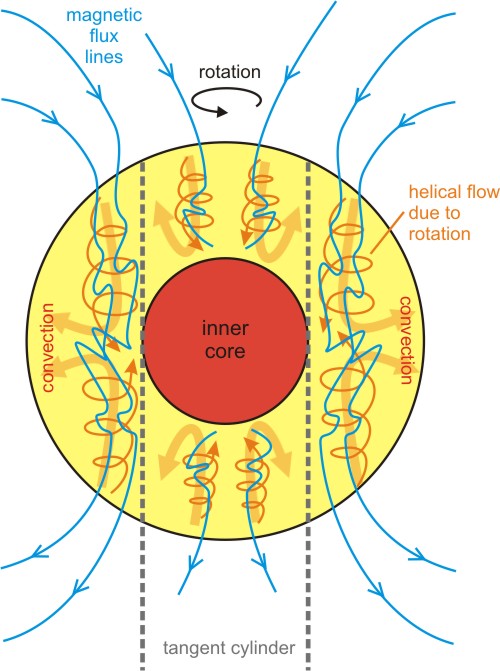
Earth is a giant magnet. This is because the core generates the magnetic field using the process called the geodynamo. The geodynamo process works like this: the outer core is full of conductive metals that is heated from below by the inner core. This drives the convection. The convection in the outer core is maintained by the heat in the inner core, and chemical differentiation. With help by the rotation of the Earth, this drives convection, and creates an instability that forms the magnetic field, and this process aligns the magnetic field to the rotational axis of the planet.

The Geodynamo Process

Magnetic fields are essential for life on Earth. That is because the magnetic field protects the planet from cosmic rays and charged particles from solar flares. When the charged particles hit the magnetic field, they become trapped and slide along the field lines moving towards the poles. The strongest areas of the magnetic field are near the poles, and if the particles are not strong enough, then they are repelled and they bounce back and forth along the field lines and that creates the Van Allen Radiation Belts. There, the magnetic field has trapped the charged particles to prevent them from reaching the atmosphere. If we didn’t have the magnetic field protecting the Earth, then the atmosphere would become stripped of its atoms and the radiation from the solar wind would irradiate all life on Earth.

Van Allen Radiation Belts

However, the charged particles also interact with the magnetic fields. The motions of charged particles in circles form magnetic fields of their own. As a result, when both magnetic fields collide with each other, Earth’s magnetic field absorbs the momentum of the charged particles, and that pushes Earth’s magnetic field back. The Earth wants to make an even magnetic field, but the Sun is pushing the magnetic fields away from the sun. It’s not an even bombardment, due to the variations in solar output.

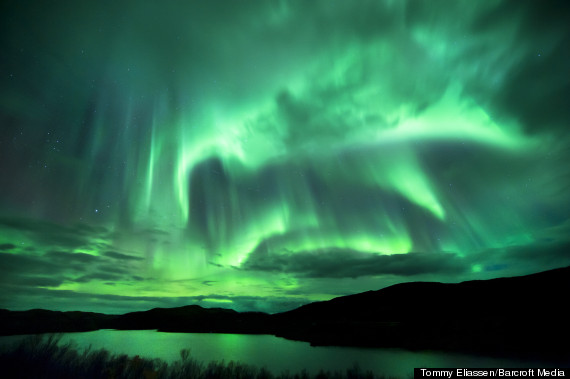
There are times when the solar wind is strong enough to overcome the magnetic field. The charged particle slides along the field into the poles, and when it is strong enough, it enters the atmosphere near the Earth’s poles, and ionizes the atmosphere. This leads to a beautiful sight called the Aurora Borealis/Australis.

Auroras over the landscape

Earth is not the only planet with a magnetic field though.

Stay tuned for my next post.


WORK CITED

http://hyperphysics.phy-astr.gsu.edu/hbase/magnetic/magearth.html

Coursera Lecture – Week 5.8

What is Earth’s Magnetic Field?


IMAGES USED

http://i.huffpost.com/gen/607838/thumbs/o-TOMMY-ELIASSEN-AURORA-570.jpg?1


Movement of Planet Earth

Hi Everybody,

Did you know that you would weigh 0.3% more if the Earth was standing still? Probably not, but it doesn’t matter because the Earth does spin. If you look at something on Earth, like a tree, or a house, it seems stationary. However, those objects, like everything else on Earth, are in constant motion. This is because the Earth, and everything on Earth, rotates every 23 hours, 56 minutes, and 4 seconds.

Hold On! We know that a day is 24 hours. How can approximately 4 minutes be missing from a day? Before we answer that, what is this day that has 23 hours, 56 minutes, and 4 seconds? This is called the sidereal day. Sidereal days have 24 sidereal hours which corresponds to a 15 degree movement of the stars per hour with respect to the Earth’s rotation. Basically, a sidereal day is a day with respect to the stars’ fixed positions. For example, if you take the star Deneb, and track its motion for a whole day, it would’ve made a complete 360 rotation after a sidereal day. This has been used since antiquity to determine time. However, why is it that we have 24 hour days, and not sidereal days?

As the Earth rotates, and sidereal days pass, it also moves along its orbit around the sun. If the Sun and Earth were aligned at noon, and a sidereal day passed, the Earth would be out of alignment with the sun. It would need an extra four minutes of rotation to realign it to the sun and reach noon. This is a solar day, and a solar day has 24 hours.

Sidereal vs Solar Day

Sidereal vs Solar Day

Another way to think about it is, as the Sun moves along the celestial sphere(the sky) from east to west, it trails by 4 RA minutes every day. The reason that we have these two standards of time is because, one clock runs 4 minutes fast. If September 21 is our start point, where midnight is 0 hr, 6 months later, on March 21, midnight is 12 hr, or noon. It creates an imbalance in time. It is simpler to have a 24 hr day where noon is noon every day of the year. It is easier to plan your daily events without taking into account the imbalance of time. It’s clear that the orbit of Earth has a profound impact on our day in many ways.

Earth orbits around the sun for one year or 365.25 days. During that orbit, it travels a total of 940 million km in space. Almost all orbits are not circular, but are ellipses. That is true for Earth as well. There are two points in any orbit called: Periapsis, and Apoapsis. (Each body has a different name for their orbital points, e.g. for Sun, Perihelion, and Aphelion). Earth has a perihelion of 147,098,290 km (0.98329134 AU) and an aphelion of 152,098,232 km (1.01671388 AU). On average, Earth has a semi-major axis of 149,598,261 km, which is 1.00000261 AU. This means its orbital eccentricity is 0.01671123, where an eccentricity of 0 is a perfect circle, anything between 0 and 1 represents an elliptical orbit, and anything 1 or greater is a parabolic orbit, or a hyperbolic orbit, respectively. While the orbit is slightly eccentric, this eccentricity doesn’t have much effect on the climate of Earth. It is seen in the fact that when the Earth is at aphelion (farthest point from the sun) in July, the Northern Hemisphere experiences summer, and when the Earth is at perihelion (the closest point to the sun), in January, the Northern Hemisphere experiences winter. The reverse is true for the southern hemisphere. The main reason why there is winter and summer is because of the tilt of the Earth.

During the year, there are four major events that occur: The Winter and Summer Solstices, and the Autumnal and Vernal Equinox. Imagine two lines on Earth, the equator, and the ecliptic. The ecliptic is 23.5 degrees tilted with respect to the equator. This simulation will help you imagine both lines. The equinox occurs when the sun reaches the point where the ecliptic and the equator intersect. At this time, both the Northern and Southern Hemispheres have an equally long day and night. The Solstices occur when the sun, on the ecliptic, is at the highest point away from the equator. At that point, it is angled towards one hemisphere and away from the other. For example, An observer in Canada, on June 21, will see the sun at its highest inclination, whereas an observer in Chile will see it at its lowest inclination. This means that the hemisphere that is tilted towards the sun will experience longer days and shorter nights, whereas the other hemisphere will experience shorter days and longer nights. Click here to see the seasons in action. This process repeats every 365.25 days, but not quite.

While an Earth year is 365.25 days, the definition of a year has been refined over the centuries. Earth has a sidereal year of 365.2564 days. This is the time it takes for the Earth to return to the same position with respect to the sun. For example, starting September 21, 1 sidereal year later, it will be in the same position. Our modern calendar year is 365 days. This is problematic because as these additional 1/4 days accumulate, it will add up and cause problems. Every four years you are off by day. After 720 years, you have 180 extra days, and that means January is summer in Northern Hemisphere, which is a problem if you are keeping time. Luckily, Julius Caesar was able to figure that out and is able to legislate the leap year. He has introduced the leap year, and as a result, we never drift more than a day. However, that is not enough.

Our calendar doesn’t drift more than a day, but it still doesn’t match the seasons. The calendar does take into account the length of the year, and the tilt of the Earth, but it doesn’t take into account the precession of the axial tilt. This precession causes the Earth’s tilt to rotate westward ever so slightly. This means that Polaris won’t be our north star forever. This precession completes its rotation every 26,000 years. While the effect is quite insignificant, it does affect our calendar, because year after year, the precession shortens the time between seasons. This results in the tropical year, which has 365.2422 days, which is slightly shorter than a sidereal year. As a result, to account for the axial precession, Pope Gregory XIII, in the 16th century, corrected for the difference between the sidereal year and tropical year by removing the leap years of centuries not divisible by 400. For example, years 1700, 1800, 1900 do not have leap years, but 1600, 2000 do have a leap year. This correction, and the tropical year is what the Gregorian calendar is based on, and this calendar allows our timekeeping to remain consistent for many years to come.

The path of Earth’s axial precession

What the precession looks like.

So what did we learn today? We learned a lot about the movement of Earth. We learned about what is a sidereal day, and what makes it different from a solar day. We learned about the orbit of Earth and what occurs during that orbit. We also learned about what makes our calendar the way it is today. I hope you all found this interesting.

Stay tuned for more blog posts…

WORKS CITED

How Fast Does the Earth Rotate?

http://astro.unl.edu/classaction/animations/coordsmotion/eclipticsimulator.html

WORKS CONSULTED

Coursera Lecture – Week 1.4 – 1.7, 1.10

http://en.wikipedia.org/wiki/Earth%27s_rotation#True_solar_day

http://en.wikipedia.org/wiki/Earth%27s_orbit

IMAGES USED

VIDEOS USED

http://www.youtube.com/watch?v=FmCJqykN2J0 – NASAEarthObservatory

About Our Planet Earth

Hi everybody,

It’s an amazing thing to look into the sky and look at the other worlds that exist. However, it all starts on the planet that we know the most about: the planet Earth.

Earth from Apollo 8

Earth from Apollo 8

Earth is a rocky planet located in the Solar System. It is the third planet from the sun. It is the most dense planet in the solar system, and the only planet to support life. It has one natural satellite, The Moon, and many other artificial satellites sent up by humans. It has a mass of 5.97219E24 kg, and orbits 1 AU or 149,597,870,700 m from the Sun.

Believe it or not, Earth is the only object with a name that doesn’t originate from Greek/Roman mythological figures. If it were, it could’ve been called Tellus (not Telus!) or Gaia, using Roman or Greek names respectively.

Planet Formation

Earth was formed during the formation of the Solar System. It is 4.5 billion years old. During its formation it accreted many smaller asteroids and planetesimals to form a protoplanet. In Earth’s early history, it is conjectured that a mars-sized protoplanet collided with the Earth and released all kinds of silicates into orbit which accreted to form the Moon. When the moon formed, it was really close to the Earth. As the system orbited the Sun, the Earth and Moon exchanged angular momentum, which slowed Earth’s rotation period and pushed the moon’s orbit outwards. This resulted in today’s Earth and Moon system.

Formation of a Moon

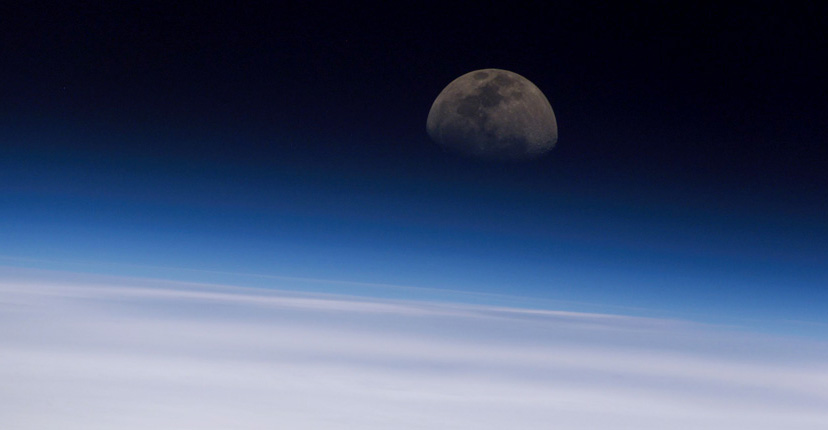
Atmosphere of Earth with Moon in the background

The planet’s atmosphere is 77% Nitrogen (N2), and 21% Oxygen (O2), with traces of other gases. Earth has a lot of free N2 in the atmosphere because it couldn’t form rocks with Silicon, Calcium, Sodium, and other elements to form rock, unlike O2 which formed rocks with these elements. In addition, N2 is quite stable, even under the influence of solar radiation. It has built up over time, unlike O2, which is consistently being recycled in Earth. In the past, the atmosphere, most likely, had a lot more Carbon Dioxide (CO2) than now. This was due to Earth’s formation. However, when water was introduced in the atmosphere, the raindrops was able to lock the CO2 in carbonate rocks, absorb inside the ocean, and eventually was used in photosynthesis. Now, there are traces of CO2 and it is increasing due to industrial processes, however, these traces (before and after human pollution) help trap heat to keep the climate in check using the greenhouse effect. It is also that same reason why Venus is the hottest place in the Solar System.

Earth’s Interior

The Earth has many layers. Earth has a crust, upper mantle, lower mantle, an outer core and an inner core. We learned about these layers by using sound waves. As one goes downards to the core, it gets hotter and denser. The reason the core is so hot is because the core generates heat using radioactive decay 80% of the time, and Kelvin-Helmholtz processes 20% of the time. The heat is transferred to the top by using circulation cells in the mantle. The core and outer core are made up of heavier elements, like iron, and nickel, whereas the mantle and crust is made up of lighter silicate materials. This is because, when Earth, during its formation, accreted enough mass, the heat of collisions and radioactivity causes the Earth to melt, and then the process of chemical differentiation takes place. The heavier elements sink towards the centre, whereas the lighter elements float to the top. This occurs when planetesimals becomes protoplanets. Today, due to plate tectonics, erosion, and other processes, most of Earth’s geologic history has been erased.

Earth

As far as we are concerned, Earth is the only planet that can support life. It is predicted that Earth’s biosphere started to form 3.5 billion years ago. Once life moved into land, the biosphere became divided into different biomes. The type of biome depends on its latitude, height from sea level, and humidity of area. For example, humid lowlands at equatorial latitudes produce very diverse biomes whereas extreme latitude, high height, and extreme humidity produce different biomes. In Earth’s history, there have been five major extinction periods, with the most recent occurring 65 million years ago, killing off all the dinosaurs. Eventually, the mammals diversified and a certain ape-like species of animal evolved to stand upright, and it eventually led to the evolution of humanity. Today, humans have evolved greatly with various innovations and technological advancements. In addition, the search for life beyond our solar system is increasing at a rapid pace. Astronomers, scientists, and looking at other stars and finding exoplanets that have the potential to support life.

Stay tuned for more information about our planet Earth.

WORK CONSULTED

Images used

Light Pollution

Four days ago, after a series of cloudy and rainy nights, the sky finally cleared for a rare view of the night sky. Taking advantage of that, I decided to take my telescope out for the night and use my piggyback mount.

A piggyback mount is an attachment for telescopes that allows a camera to be attached on top of it. Using the tracking feature of the telescope, one could take long exposure images of the sky for a long time and avoid sky trails, which occurs when a camera takes a long-exposure image of the stars without compensating for the Earth’s rotation. Below is an example of star trails:

IMG_0161During that night, my goal for the night was to take a long exposure shot of the sky using my piggyback mount. However, I failed to realize that the light pollution in my backyard and the moonlight in the sky would obstruct the view of the stars in the sky, and that seeing conditions for the stars would not be optimal.

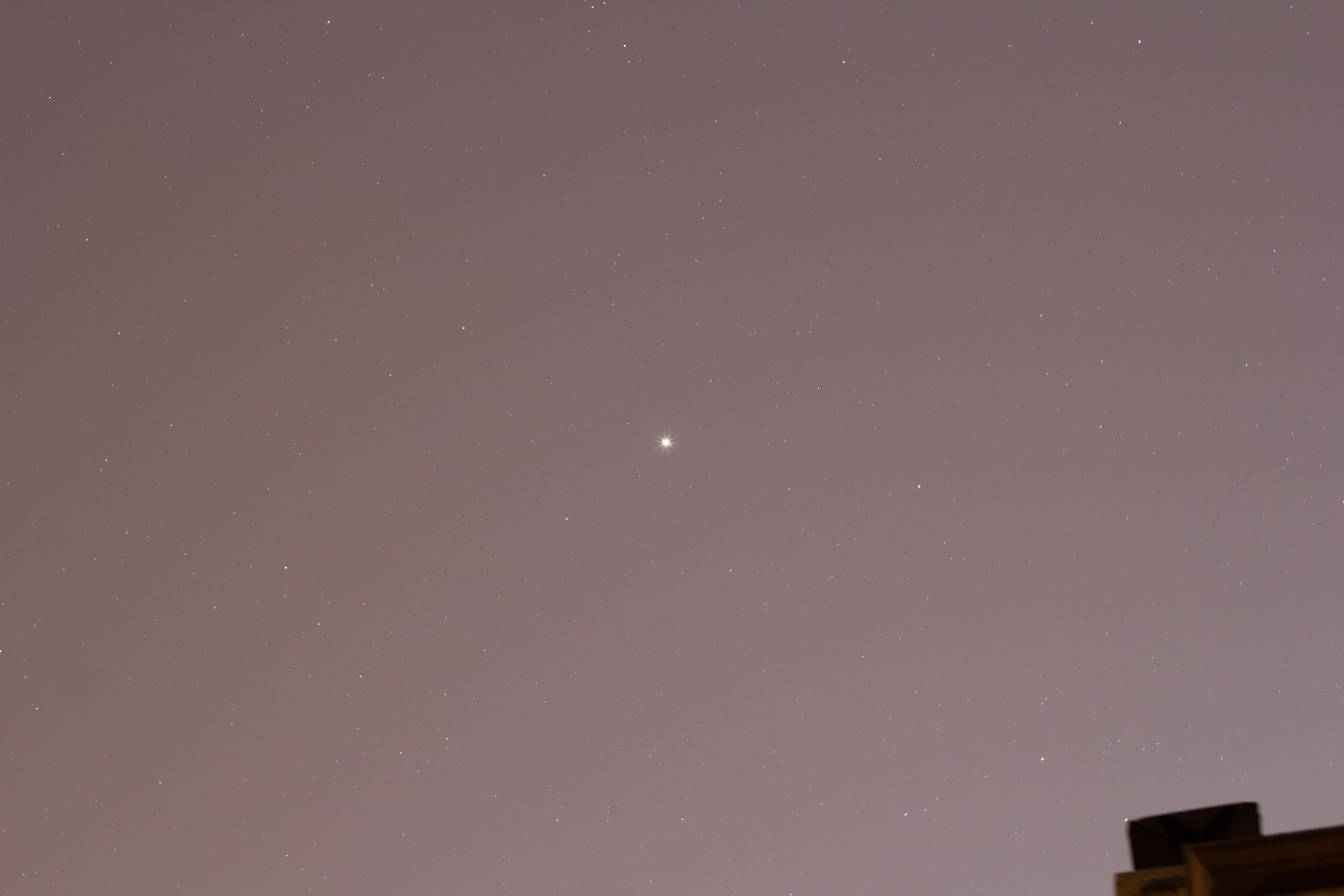
When I was taking the pictures of the sky, I was expecting to see crisp black images with stars shining brightly. Instead I got an image with dim stars and a bright background blocking the stars. This is due to the light in the sky blocking the stars. The light is coming from the Moon and from the light pollution.

IMG_0202

An image of Jupiter on a brightly illuminated sky

Light pollution is when artificial light shines at the sky and obstructs the view of the stars. It can come from the car lights, lights from buildings, and especially from streetlights to name a few. Light pollution is most prevalent in urban areas, such as Downtown Toronto, New York, Yerevan, and many other major cities. However, light pollution declines as you move away from the urban centres.

For example, if one was in an urban centre like Downtown Toronto, or Yerevan, and you looked up into the sky, you would likely only see the Moon, the planets, and the odd star. Far out of the city, like in Algonquin park, there is very little artificial light, which will give you an excellent view of the sky, and maybe even the Milky Way.

Light Pollution is a major problem in many cities. However, there are organizations who are committed to reducing the amount of light pollution in our cities. One such cause is: Light-Pollution Abatement Committee operated by the Royal Astronomical Society of Canada. This committee was formed to work with the municipal, provincial, and federal governments as well as with concerned citizens to reduce light pollution and create darker skies for all to enjoy. They encourage people, organizations and governments, to advise each group of the situation at hand and talk to each other and find solutions.

If you want to help as well, iOS users can download two apps that can help one find clearer skies, and help identify light polluted areas. The first one is “Dark Sky Finder”, which is a map of North America, Europe and Australasia that charts out the level of light pollution in certain areas, like Toronto, New York, Sydney, and other cities. The other app is the “Dark Sky Meter”. It allows one to measure the night sky and see how dark it is compared to total darkness. In addition, users can submit the data that they find to the Save Our Stars (SOS) program, which will assist the SOS program in their efforts to chart light pollution in our skies. The links are:

http://www.jshine.net/astronomy/dark_sky/

http://www.darkskymeter.com/

After some time, I decided to call it a night, and brought my telescope into my house.

A few days later, I was thinking about what my priorities should be during this period of the Full Moon. Knowing that the moon and the surrounding light will obstruct my view of the stars, I decided to recommit myself to observing the Moon when it is visible in the sky. When the next clear night comes, I will be there to see the Moon.

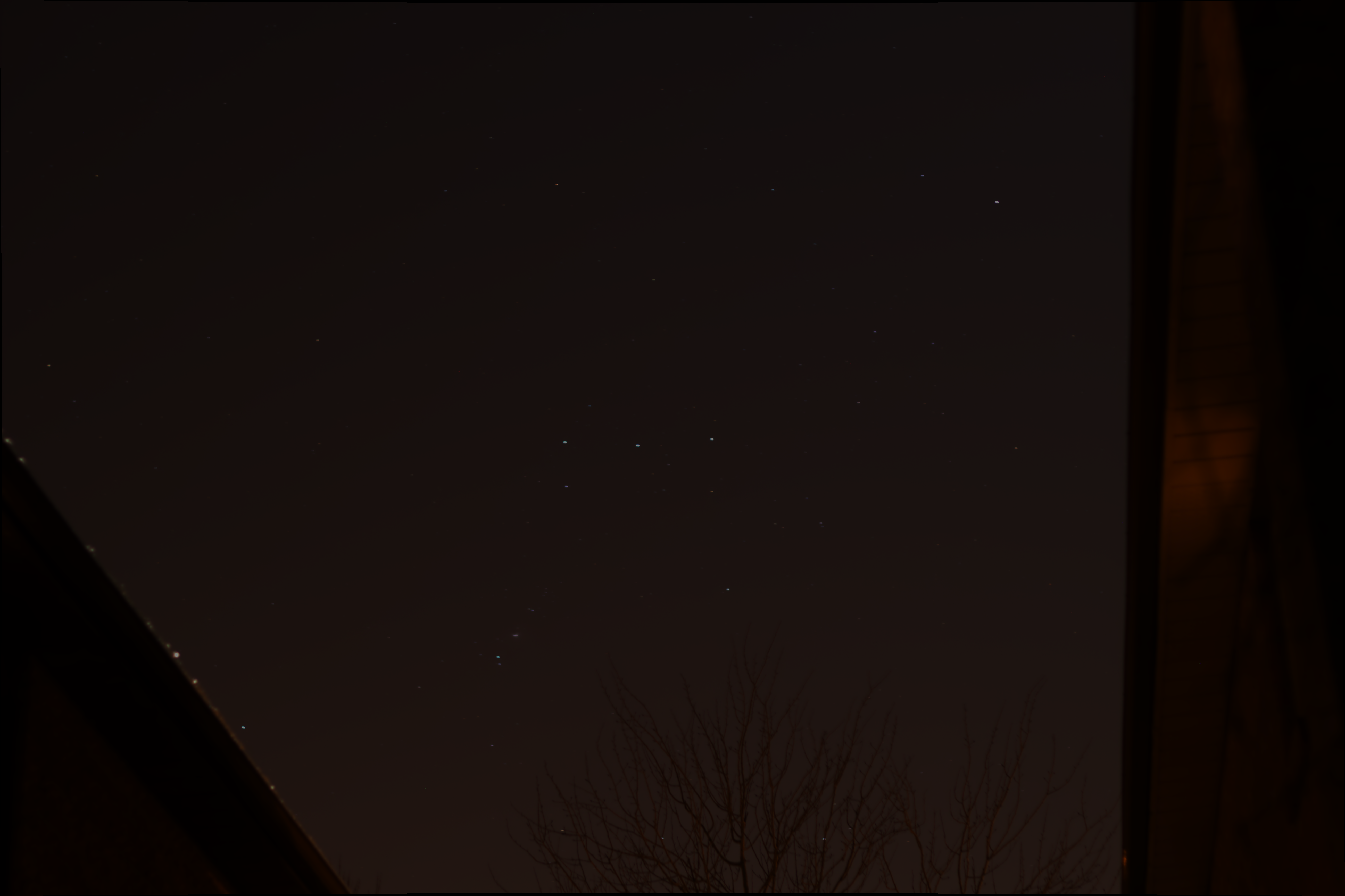
Today, I processed a number of images that I took and I achieved this result:

IMG_0198

The night sky post-processed.

IMG_0212

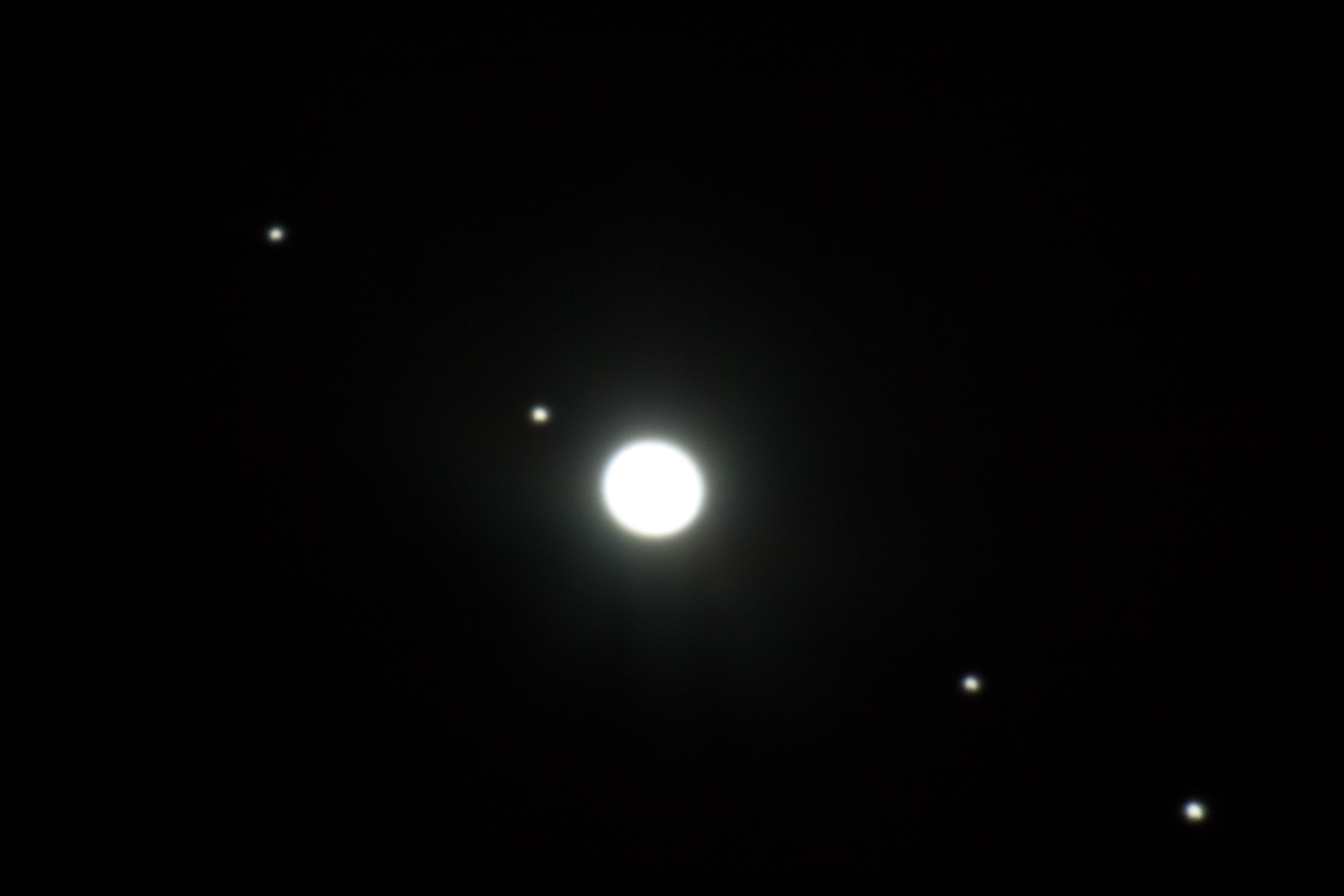
Jupiter through a DSLR Camera. Post-processed

WORKS CONSULTED

http://en.wikipedia.org/wiki/Light_pollution

http://www.rasc.ca/lpa