Sudbury Skies

On Sunday, May 18, 2014, during the Victoria Day long weekend, I was up in Sudbury with my family. We were blessed with beautiful night skies, and as a result my dad and I decided to take advantage of it and observe the night sky. We went outside to a clear area in our surroundings. After setting up the scope, it was ready to align.

We saw very unusual objects. There were fast moving objects in the sky moving as a group. We thought they were UFO’s at first, but we realized that they were birds flying across the sky. It was unusual to see these birds illuminated at night, even though Sudbury is a pretty dark place. However, due to the construction around the land, there were a lot of lights pointed towards the sky. Those lights illuminated the birds quite brightly, which led to that confusion. After clearing that up, we continued on with our astronomical goals.

We first aligned the telescope with Mars. Looking at Mars, it was a beautiful red dot that shined brightly in the sky. Unfortunately, we couldn’t make out any details on it. Looking at the sky, we also found Saturn and Jupiter in the sky. Saturn was moving upwards away from the horizon, and Jupiter was moving towards the horizon. From the locations of Jupiter, Saturn and Mars, I drew a line between them to see where the ecliptic was. The ecliptic is the path the sun takes when it rises and sets every day. I was able to estimate the location of the ecliptic, because all the planets orbit close to the plane of the sun, thus we see the rising and setting of planets near the same location as the ecliptic. It is quite interesting. After realizing that, we soon decided to slew to Saturn.

After slewing to Saturn we saw a brilliant planet surrounded with beautiful rings. It was a sight to see, especially up in the Sudbury sky. Looking around for another target, we saw a star that was flickering in the atmosphere between different colours. It was intriguing to my dad and me. I thought it was a variable star. However, my dad believed it was a star that was so low in the atmosphere that the atmosphere was dispersing the light. I’m not certain, but it could be it. We slewed to it and saw the fluttering star. However, at midnight, the clouds started to come in and block the starlight. With that, we decided to pack the telescope back into the truck and return inside.

Back in Action

I had telescope troubles earlier this year. As a result, I was out of commission for a large part of the year. Earlier, this week, my dad was able to resolve one of those troubles, and On Friday, May 16, 2014, I took the newly resolved telescope on a test run.

Once I brought everything out, I decided to align my telescope to Mars. My biggest worry in the repairs is that the tracking ability of my telescope would not work. After aligning it to Mars, I left it pointed at Mars for a while. When I returned to Mars, it hadn’t drifted from its position. This is a good sign that tracking is still working in the fixed scope.

After checking it a few times, it had drifted but not enough that tracking failed completely. I was happy with the results I was seeing. To see if tracking works away from the alignment object, I slewed my telescope to a random star. Leaving it for a while, the star did drift, but not far enough to conclude that tracking is not working. As far as I am concerned, tracking was working. I was really happy with the results I was seeing.

My next test took place in the opposite part of the sky. There was a dim star in the Western part of the sky, which I pointed my scope at. I looked at it for a while. I had to readjust my scope a couple of times, but it didn’t drift fast enough to conclude that tracking was failing. I was really impressed with the great job my dad did in resolving the issues in my telescope.

Lastly, aligned to Mars, I decided to point my scope at Saturn. There, it drifted a great distance, which concerned me. If it didn’t track with Saturn, then what is the problem? Has the gear burnt out? Has the software failed? Luckily, there was no problem. Saturn was able to stay inside the field of view of my telescope for a long time after readjusting it back to the center of my field of view. This confirmed the results that I had received, that my telescope troubles were over at last.

Happy with the results of my test run, I decided to pack up my telescope, and bring it inside. However, I wasn’t done. Before packing, I saw the rising of the moon through dense trees. This gave me the idea of watching the Moon rise. Therefore, after packing up and bringing all my equipment inside, I decided to head to a dark spot where the moon can be easily observed. Sadly, the moon had already risen, but it was no less beautiful. With my tripod and camera, I was able to compose a number of images of the scene with the moon in the background. It was very nice. A short while later, when it started to get too cold. I packed up and headed home. I was very happy with the results of that night, and with my telescope troubles officially over, I can continue to observe and image in the near future.


Sunspots and Solar Flares

On Tuesday, May 5, 2014, as part of astronomy week, the Royal Astronomical Society of Canada (RASC) hosted a solar observation event at the Ontario Science Centre. I was able to attend this event and observe the sun with a variety of telescopes. Most telescopes are using Baader film, which makes the sun look white, and hides the solar flare and prominences, but clearly shows the sunspots on the sun.

Another telescope called the Coronado PST uses a hydrogen-alpha filter. All the light, except the hydrogen-alpha light are filtered out and the sun glows red. The image projected shows the sun, but the sunspots are unclear. However, the solar flares and prominences are visible.

Looking at the sun using those telescopes was very intriguing. In my previous blog post, I talked about how the magnetic field of the sun works to form sunspots, prominences, and other solar activity. Going to RASC’s solar observing event gave me the opportunity to observe what I wrote about. I was able to see the sunspots. They were close enough to look like an arc was there. On the Coronado PST, there was a prominence or a flare visible from the top right of the image. It was an amazing feeling to see the sun so alive and so active.

The Sun through Hydrogen-alpha filter via Coronado PST.

I encourage anyone living in Toronto to come to the Royal Astronomical Society of Canada`s events. You can go to their website at: rascto.ca

To learn about solar activity, go to: https://jolyastronomy.com/2014/05/05/magnetic-fields-from-the-sun/


Magnetic Fields: From the Sun

It’s not just the planets that have magnetic fields. The Sun also has a very large and dynamic magnetic field.

The sun’s magnetic field is formed much like on Earth and Jupiter. There are convection cells that bring heat from the sun’s heat sources to the surface. These convection cells, and the sun’s rotation period of 25.4 Earth days produce the sun’s magnetic fields. However, there are many notable differences.

These granules on the sun are convection cells.

The sun is over 12,000 times larger than the Earth, which means that its magnetic fields are larger as well. It’s so large, it extends past the orbit of Pluto. However, it isn’t a solid object, like Earth. The sun’s material is mostly plasma, which works like a gas; like Jupiter. This means that the sun experiences differential rotation, where the equator rotates faster than the poles. On the sun, its Equator rotates every 25.4 days, but its poles rotate every 29 days. This video will demonstrate what that does to the sun.
When the sun rotates, the equator stretchs the magnetic field lines towards the sun’s direction of rotation, and it will keep stretching it until they snap like rubber bands. When they snap, they release the energy in the magnetic field and the magnetic field lines pop out of the sun. These magnetic field lines cause the charged particles from the surface to become trapped along the magnetic field lines. Those trapped particles are called prominences. In addition, Sunspots are formed where the magnetic field lines poke out and in, when the charged particles are lifted from its surface. That is why sunspots are common during periods of high solar activity, like the Solar Maximum.

Eventually, the magnetic field lines will reconnect with each other, and release a lot of energy, leading to large solar flares, and coronal mass ejections. At the same time, the polarity of the magnetic fields will reverse. When the flip is complete, the sun’s magnetic field will drop to zero, reappear in its reversed polarity, and start the process again. This process occurs every 11 years and after each cycle, the poles reverse.

Today, there is evidence that the Sun’s magnetic field is in the process of flipping after a chaotic solar maximum. Once the flip is complete, the process starts again.

Here is a video that talks about the sun and its solar cycle by NASA:


Thank you for reading! For my next topic, I want to hear from you. What do you want me to write about next time? You can respond by going to the contact form at: http://www.jolyastronomy.com/contact-me/  Thank You.

WORKS CITED

Coursera Lecture 6.6

http://www.windows2universe.org/sun/activity/sun_mag_field_rotate_tangle.html

http://www.windows2universe.org/sun/solar_activity.html

http://www.windows2universe.org/sun/activity/sunspot_cycle.html

http://www.windows2universe.org/sun/activity/solar_cycle.html

http://www.windows2universe.org/sun/sun_magnetic_field.html

http://www.windows2universe.org/sun/atmosphere/solar_flares.html

http://www.usatoday.com/story/news/nation-now/2014/01/06/sun-magnetic-field-polarity-reverse/4306845/

http://news.nationalgeographic.com/news/2013/08/130807-sun-magnetic-field-reversal-space-weather/

http://www.space.com/23551-sun-magnetic-field-flip-video.html


IMAGES USED


VIDEO USED

Astronomical Events for May 2014

Hello everybody,

Here are the astronomical events occurring in the month of May: (All times are given in UTC format)

       Astronomical Events

  • May 3: For viewers in North-West Brazil and Peru, at approximately 9:17 am, asteroid 105 Artemis will occult a +7.7 magnitude star.
  • May 4: For viewers in Peru and Ecuador, at approximately ~10:12, asteroid 34 Circe will occult a +7.4 Magnitude star.
  • May 6: The closest lunar apogee will occur at 10:23 with the moon being 404,318 km distant from Earth.
  • May 5-7: The Eta Aquarid meteor shower will peak. This meteor shower started at April 19, and end on May 28, but the most meteorites you will see will be on May 5-7. This meteor shower is made up of the remains of Halley’s comet. The first quarter moon will be present at the beginning of the night, but after 12 pm, it will set and the sky will become dark enough to view the meteor shower. While, they can come from anywhere, their origin will usually be from one point, and in this case, it is from the Aquarius constellation. Comets will leave gas behind when it ejects gas. That dust is scattered about its orbit, and when the Earth intersects with the comet’s orbit, then more of the comet dust will enter the atmosphere, and form a meteor shower. Since they are orbiting the same direction, it appears to all come from one point in the sky. That is called the radiant. This dust is how meteor showers occur.
  • May 7: For Australia and Indonesia, asteroid 206 Hersilia occults a +7.5 magnitude star at approximately 17:49.
  • May 10: Saturn reaches opposition. It is shining with a magnitude of +0.1. It’s rings are tipped over a maximum of 23 degrees into our line of sight on February 11th, and will widen overall in 2014.
  • May 13: A double transit event will take place on Jupiter from 9:20 – 9:32 visible from North-west North America.
  • May 14: The moon will occult Saturn on approximately 12:18. This will be visible in Australia and New Zealand.
  • May 24: A meteor shower may occur here thanks to Comet 209P LINEAR.
  • May 24: For South America, Asteroid 33 Polyhymnia occults a +5.5 magnitude at approximately 8:30.
  • May 25: Mercury reaches maximum dusk elongation, 22.7 degrees east of the sun. This is Mercury’s best evening apparition for 2014 for northern hemisphere viewers.

         RASC Toronto Centre Events (These times will be written as EST or EDT)

  • May 3-4: the AstroCATS will take place. It is a trade show that features seminars, guest lecturers, exhibitions, and many other events. There is also a special hotel accomodation for the guests. It’s going to be fun.
  • May 5 – 8: RASC will be hosting a city star party at either Bayview Village Park or at High Park. These parties are dependent on the weather, and a window is set for the party. If a night is clear, RASC gives the GO call and the party will take place that day. If a NO GO call is given, the party is postponed until the next day when another GO/NO GO Call is given. If all the days in the window were given a NO GO call, then the party is cancelled for the month, and will try again next month. If a GO call is given, guests start setting up their telescope at around 7:30 pm. Go to rascto.ca for more information and for the GO/NO GO call. It’s free to attend for the whole public.
  • Wednesday, May 7: Marshall L. McCall, who works at York University’s Department of Physics and Astronomy will talk about the arrangement of galaxies all around us and how that affects us. It will take place at the Ontario Science Centre. It is free to attend, and everyone can attend.
  • May 21: It is RASC’s Recreational Astronomy Night. It will take place at the Ontario Science Centre from 7-10 pm. Parking is free after 6 pm. There will be four speakers: Francois van Heerden will discuss the sky this month. Jason Toliopoulos will discuss Astronomy for dummies… by dummies. Francois van Heerden will give an update by the RASC board of directors. Lastly, Paul Mortfield will give tips to help us bring astronomy to people at star parties. It is free to attend, and anyone can attend.
  • May 24-25: Members have the opportunity to work at the E.C. Carr Observatory. This is the Carr Observatory Spring Work Party. It’ll allow you to get hands on experience in working at an observatory. There is room for everyone there. It is for members only, but members can attend for free. It is at Blue Mountain. Go to rascto.ca for more details.
  • On May 26-29: RASC will be hosting a Dark Sky Party at the Sault Lake Conservation Area. At this party, it will be dark enough to view the faintest objects in the sky, such as M51, Andromeda Galaxy, and many other Deep Sky Objects (DSO’s). This event is weather dependent, therefore go to rascto.ca for the GO/NO GO call. It is free to attend, and everyone can attend. Telescopes not mandatory.
  • Go to http://www.rascto.ca for more information. Thank You!


WORK CITED

101 Astronomical Events for 2014

Coursera lecture 5.12

http://www.iflscience.com/space/skywatching-events-not-miss-2014

rascto.ca

The Tetrad of Lunar Eclipses

Taking a break from magnetic fields, I wanted to talk about a very rare event that started taking place on Tuesday, April 15, 2014. The first of four lunar eclipses took place that night. This is a rare event as this tetrad of eclipses will occur six months apart from each other; the first one on April 15, 2014, the next on October 8, 2014, the third on April 4, 2015, and the last one on September 28, 2015. All of the eclipses will be visible from North America.

All these eclipses will be total eclipses. That is when the entire moon is completely engulfed in the Earth’s shadow. This is the most spectacular eclipse as the whole moon turns a bright red, reminiscent of a sunset. This is also called the blood moon. The next kind of eclipse is a partial eclipse. This is when the Moon crosses into the Earth’s umbra, but is not completely consumed by it. The last and least noticeable is a prenumbral eclipse. The Moon enters the Earth’s prenumbra, but doesn’t cross into the umbra. This is a very subtle eclipse. The most one will notice is a drop in brightness. Luckily for us, all the eclipses during this tetrad of eclipses will make the moon glow red. But why red?

That is because, when the sun obstructs the Earth, most of the light is being blocked, but the light hitting the atmosphere is bending towards the Moon. While that occurs, the atmosphere is also scattering the shorter wavelengths of the spectrum into the atmosphere, leaving behind the red wavelength, which is the longest and the least likely to scatter. This is why the moon looks red during a lunar eclipse, and this is why sunsets are red.

Unlike a solar eclipse, this eclipse is safe to view without any eye protection, and it is visible across a whole continent, whereas solar eclipses are visible in a thin, 250 km region during its path. That will be another post…

Thank You for reading.


WORKS CITED

http://www.cbc.ca/news/technology/total-lunar-eclipse-last-night-was-the-1st-of-4-1.2610637

http://science.nasa.gov/science-news/science-at-nasa/2014/27mar_tetrad/

A Red Moon – NOT a Sign of the Apocalypse!

http://news.nationalgeographic.com/news/2014/04/140410-lunar-eclipse-blood-moon-space-viewing-guide/


WORKS CONSULTED

http://www.answersingenesis.org/articles/2013/07/12/lunar-eclipses-cause-blood-moons

http://americanlivewire.com/2014-04-14-why-does-the-moon-change-colors/


Magnetic Fields: On Other Planets

Hi everybody,

We ended the previous post with mentioning that Earth is not the only planet with a magnetic field. All the planets, with the exception of Venus and Mars, produce magnetic fields.

Mercury, the closest planet to the sun, and one of the smallest planets in the solar system, has a magnetic field. It is thought that Mercury’s large core is doing the geodynamo process to produce the magnetic field, however, it has not been confirmed yet, and there are other ideas floating around. Mercury’s magnetic fields are only 1% the strength of the Earth’s, however, it is strong enough to repel solar flares. Currently, the MESSENGER probe orbiting mercury is working to learn more about Mercury’s magnetic field using a variety of instruments. Of the inner planets, Venus and Mars are the only planets that do not produce magnetic fields.

Mercury’s magnetic fields with MESSENGER’s orbit.

Venus is similar to Earth in some ways; however, it doesn’t produce a magnetic field. While our knowledge of Venus is incomplete, there are a few conjectures as to why that is. The first one is that the core has solidified and there is no convective outer core to convect any conductive fluids, and thus no magnetic field could be produced. Another conjecture is that, since the planet went through a major resurfacing event, the crust has effectively sealed the core in, and the core became heated to a uniform temperature which doesn’t promote convection. Another theory is that in addition to the lack of convection, Venus is also rotating so slowly (243 days/Venus Day)- it isn’t moving fast enough to produce any magnetic fields. Since Venus doesn’t have a magnetic field, and any solar flare will interact with the ionosphere directly, the ionosphere will slow the flare down and redirect the flow of charged particles. Since the atmosphere is dense, and Venus’ winds are intense, the ionosphere will prevent the charged particles from reaching its surface. Despite all we have learned about Venus, these theories are still conjecture, and it will be difficult to find answers due to Venus’ harsh conditions. We have more complete information about Mars, however.

Venus’, Earth’s, and Mars’ interactions with Solar Flares


Mars is different, in many ways, from Venus and Earth, but like Venus, it doesn’t have a magnetic field. It has an ionosphere present, but the atmosphere is quite weak; therefore, the planet isn’t protected by any solar flares. Its mantle is presumed to be inactive, and its core is already small, having never accumulated enough iron, therefore convection in the core stopped and the magnetic field ceased to exist. However, there are traces of a magnetic field in Mars’ past found frozen into the rocks on Mars that are over 4 billion years old. There is a theory that Mars’ magnetic field was destroyed when a large asteroid impact interrupted the convective process of Mars, which stopped the production of the magnetic field. It is under debate, though, as some might consider that Mars’ geodynamo process ended when the core cooled enough to stop the convection process on its own. It makes sense since Mars is smaller, and lighter. It would take a shorter amount of time to cool down than Earth would. Since the magnetic field ceases to exist, the solar flares were able to strip away Mars’ outer atmosphere and kill any life on Mars. Unlike some inner planets, all the outer planets have magnetic fields.

Outer Planets


The magnetic fields of the outer planets

All the gas giants have magnetic fields, with Jupiter having the strongest magnetic fields of them all. The magnetic field works much like Earth’s, with the geodynamo process originating from its metallic hydrogen outer core and its fast rotation period. However, it is 100 times larger and extends 20,000 greater than Earth’s magnetic field. Some say that the tail of the magnetic field extends as far as the orbit of Saturn. It’s so big that it begins to repel a solar flare 3 million kilometres away from Jupiter. However, because of its larger distance from the sun, the intensity of the solar wind is 4% that of the Earth’s. This means, less effort is needed to repel it. Much like Earth, Jupiter has a set of radiation belts that trap any charged particles heading towards it. It is 1000 times stronger than Earth’s radiation belts. In addition, the magnetic fields also receive particles from its innermost moon, Io. The sulphur, and oxygen Io emits from its volcanoes create a ring of gas that interacts with the magnetic field and collects it, which creates a gas torus. Spacecraft visiting Jupiter will need to overcome the intense radiation present in its magnetic fields.

Saturn’s magnetic field is the second largest in the whole solar system. It works a lot like Jupiter’s, but it is only half of its strength. This is because; the metallic hydrogen outer core that conducts the geodynamo process is smaller than Jupiter’s. When the magnetic fields interact with the solar flare, they interact from 20 Saturn radii away, and its tail extend much farther than that. The magnetosphere has many taurii, originating from Enceladus, and Titan. Enceladus ejects a large amount of water vapour into space. The water vapour ionizes and rotates with the magnetic field. Eventually, it escapes through the magnetotail. Titan has a large amount of Nitrogen ion plasma and is released into Saturn’s inner magnetic fields. There might be other sources inside Saturn’s rings, inner moons, or the upper atmosphere. When the solar flare hits Saturn, much like Earth, aurorae are formed on Saturn spanning the whole spectrum of light. Spacecraft visiting here have to overcome its intense radiation as well here.

Uranus’ magnetic field is 0.1 times that of Saturn. Before Voyager 2 arrived there, no experiments took place there of its magnetic fields. They expected a magnetic field similar to the ones they knew, such as Earth’s. However, measurements revealed two major differences: Uranus’ magnetic fields aren’t in line with the center of the planet, and that it is tilted 59 degrees from the rotational axis. This means the magnetic field produced is asymmetric across the whole planet. One theory to suggest why it occurs is that, unlike the other planets where the magnetic fields are generated in their cores, Uranus’ magnetic fields is formed closer to the surface, such as in a water-ammonia ocean, where convective movement could take place. Since the magnetic axis is highly inclined with respect to the rotational axis, the magnetotail would be wound into a corkscrew shape. In addition, the radiation belts are mostly made of Hydrogen ions, which suggest that there are no taurii present from any of its moons. However, despite its differences, its magnetic fields are similar to Saturn’s magnetic fields.

Uranus and Neptune’s magnetic fields

Neptune is very similar to Uranus and is the only other planet to have similar magnetic fields to Uranus. Its magnetic field is titled relative to the rotational axis by 47 degrees and offset by 0.55 Neptune Radii. Comparing it to Uranus, it is likely that there is convective flow in a shell of conductive liquids that drives the geodynamo process. When the solar wind interact with Neptune’s magnetic fields, it starts to repel it at 34.9 Neptune Radii, and the magnetotail extends at least 72 Neptune radii, and probably farther. In addition, it is found that there are aurorae on Neptune, but much weaker than those of Earth. These results were verified by Voyager 2’s visit to the two ice giants.


However, one more celestial object has a magnetic field, and during an 11 year period, it produces noticeable black spots on it. Stay Tuned for the final segment.


WORKS CITED

http://hyperphysics.phy-astr.gsu.edu/hbase/magnetic/magearth.html

Coursera Lecture – Week 5.8

What is Earth’s Magnetic Field?

http://genesismission.jpl.nasa.gov/science/module4_solarmax/solarmax_planets.html

https://www.windows2universe.org/physical_science/magnetism/planetary_magnetism.html

http://en.wikipedia.org/wiki/Mercury%27s_magnetic_field

http://messenger.jhuapl.edu/why_mercury/q3.html

http://image.gsfc.nasa.gov/poetry/venus/V3.html

http://phys.org/news141573374.html

news.sciencemag.org/2009/04/did-marss-magnetic-field-die-whimper-or-bang

http://www.redorbit.com/news/space/1112773528/solar-wind-makes-venus-act-like-a-comet-013013/

http://en.wikipedia.org/wiki/Magnetosphere_of_Saturn

http://zebu.uoregon.edu/disted/ph121/js20.html

http://en.wikipedia.org/wiki/Magnetosphere_of_Jupiter

http://en.wikipedia.org/wiki/Gas_torus

http://lasp.colorado.edu/education/outerplanets/giantplanets_magnetospheres.php#jupiter

http://voyager.jpl.nasa.gov/science/uranus_magnetosphere.html

http://en.wikipedia.org/wiki/Neptune

http://www.windows2universe.org/neptune/magnetosphere/N_mag_generation.html

http://www.windows2universe.org/neptune/upper_atmosphere.html


WORKS CONSULTED

The Planet Mercury

https://www.windows2universe.org/physical_science/magnetism/generating_magnetism.html

http://lasp.colorado.edu/education/outerplanets/giantplanets_magnetospheres.php

http://www-ssc.igpp.ucla.edu/personnel/russell/papers/venus_mag/

http://www.sciencedaily.com/releases/2012/03/120305173701.htm

Click to access Luhmann.pdf

http://www.britannica.com/EBchecked/topic/525169/Saturn/54281/The-magnetic-field-and-magnetosphere

http://www-ssc.igpp.ucla.edu/personnel/russell/papers/sat_mag.html

http://www-ssc.igpp.ucla.edu/personnel/russell/papers/nep_mag.html

http://www-ssc.igpp.ucla.edu/personnel/russell/papers/ura_mag.html


IMAGES USED

http://i.space.com/images/i/000/033/427/i02/venus-earth-mars-interacting-solar-wind.jpg?1381338788

Astronomical Events for April 2014

Hello everybody,

Here are the astronomical events occurring in the month of April: (All times are given in UTC format)

       Astronomical Events

  • April 8: Mars reaches opposition with a magnitude of -1.5.
  • April 12: Venus and Neptune come to a close conjunction with both planets being 0.7 degrees apart at 2:00 UTC.
  • April 15: A total lunar eclipse will occur at 7:47. It will be visible in the Americas.
  • April 17: The Moon will occult Saturn at ~7:19. It will be visible in South America.
  • April 29: An Annular Solar Eclipse will occur at 6:05. It will be visible from Australia, and from the South Indian Ocean. It will also be a unique, non-central eclipse.

         RASC Toronto Centre Events (These times will be written as EST or EDT)

  • April 2: Dr. Amy Shaw, from York University, will speak about the OSIRIS-REx mission and its target asteroid Bennu. It will take place at the Ontario Science Centre. Parking is free after 6 pm, and it is free for the public.
  • April 5: There will be a Solar Observation Event at the Ontario Science Centre. It is free for the public. Go to http://www.rascto.ca for the GO/NO GO call.
  • Monday April 7 – 10: There will be a City Star Party, where people can look at the stars and planets without going outside of Toronto. A telescope is not necessary to attend. This event is free for the public. It will be located at either Bayview Village Park or at High Park. Go to http://www.rascto.ca for the GO/NO GO call.
  • On April 11-13, developers, engineers, and many others will take on 25 NASA-designed challenges and solve them using a variety of solutions with the help of a mentor. Anyone can attend, but registration is required. To register, go to: http://spaceappstoronto.com/ It will take place at the Ontario Science Centre.
  •  April 12: Yuri’s night will take place. It is a global celebration of humanity’s journey into space. This night takes place every April 12th. This celebrates the the first human spaceflight, and the first space shuttle launch. The party features space-related activities, such as a mix of “techno and technology at a NASA Center”, to a gathering at a bar. To find a party, or to plan your own event, go to: http://yurisnight.net/#/starter
  • On April 22: Joseph Ivor Silk will speak about his work in cosmology. It is organized by the Canadian Institute for Theoretical Astrophysics. It will take place from 7:30 – 9:30 and will be located at the Koffler Building at 569 Spadina Avenue, Room 108.
  • April 23: The RASC monthly Recrational Astronomy night will take place at the Ontario Science Centre. There will be four lectures by Chris Vaughan, Guy Nason, and Ed Treijs. This event is free and open to the public. Parking after 6 pm is free. It will take place at the Ontario Science Centre.
  • April 26: The RASC Member’s night will take place. This month’s theme is “Catch a Falling Star – A New Meteor Shower”. Members can only attend, but we can sign you up there. It is free to attend. It will take place at the David Dunlap Observatory starting at 5:30 pm.
  • April 28 – May 1: This is the window for RASC’s Dark Sky Party that will take place at the Long Sault Conservation Area. It will start at 8 pm. This event is free and open to the public. Telescope are not necessary to attend. Go to http://www.rascto.ca for the GO/NO GO calls.
  • Go to http://www.rascto.ca for more information. Thank You!


WORK CITED

101 Astronomical Events for 2014

rascto.ca


WORKS CONSULTED

Home

Magnetic Fields: Its Purpose on Earth

Hi everybody,

If you have used a compass, then you have used one of Earth’s key features to find your way. That feature is Earth’s magnetic field.

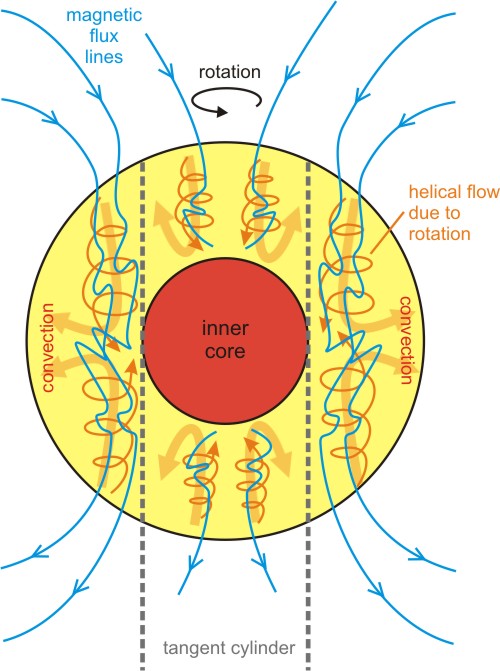
Earth is a giant magnet. This is because the core generates the magnetic field using the process called the geodynamo. The geodynamo process works like this: the outer core is full of conductive metals that is heated from below by the inner core. This drives the convection. The convection in the outer core is maintained by the heat in the inner core, and chemical differentiation. With help by the rotation of the Earth, this drives convection, and creates an instability that forms the magnetic field, and this process aligns the magnetic field to the rotational axis of the planet.

The Geodynamo Process

Magnetic fields are essential for life on Earth. That is because the magnetic field protects the planet from cosmic rays and charged particles from solar flares. When the charged particles hit the magnetic field, they become trapped and slide along the field lines moving towards the poles. The strongest areas of the magnetic field are near the poles, and if the particles are not strong enough, then they are repelled and they bounce back and forth along the field lines and that creates the Van Allen Radiation Belts. There, the magnetic field has trapped the charged particles to prevent them from reaching the atmosphere. If we didn’t have the magnetic field protecting the Earth, then the atmosphere would become stripped of its atoms and the radiation from the solar wind would irradiate all life on Earth.

Van Allen Radiation Belts

However, the charged particles also interact with the magnetic fields. The motions of charged particles in circles form magnetic fields of their own. As a result, when both magnetic fields collide with each other, Earth’s magnetic field absorbs the momentum of the charged particles, and that pushes Earth’s magnetic field back. The Earth wants to make an even magnetic field, but the Sun is pushing the magnetic fields away from the sun. It’s not an even bombardment, due to the variations in solar output.

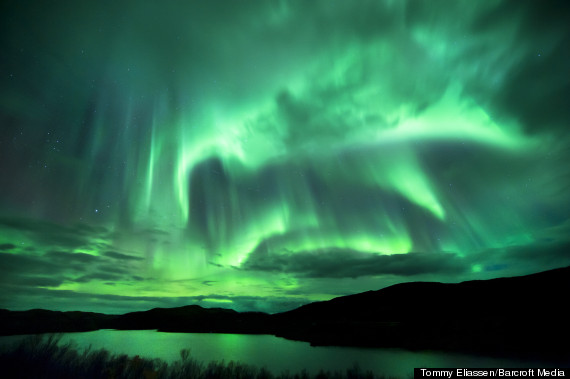
There are times when the solar wind is strong enough to overcome the magnetic field. The charged particle slides along the field into the poles, and when it is strong enough, it enters the atmosphere near the Earth’s poles, and ionizes the atmosphere. This leads to a beautiful sight called the Aurora Borealis/Australis.

Auroras over the landscape

Earth is not the only planet with a magnetic field though.

Stay tuned for my next post.


WORK CITED

http://hyperphysics.phy-astr.gsu.edu/hbase/magnetic/magearth.html

Coursera Lecture – Week 5.8

What is Earth’s Magnetic Field?


IMAGES USED

http://i.huffpost.com/gen/607838/thumbs/o-TOMMY-ELIASSEN-AURORA-570.jpg?1


The Search for M51

Friday, March 14, 2014 was clear despite a weather forecast of overcast skies. With that in mind, I decided to take my telescope out to observe the night sky and confirm what I saw last session was M51.

At midnight, I took all my equipment outside and I set my telescope up for observation. However, when I turned the mount on, it gave me errors 16 and 17. Both altitude and azimuth motors were unresponsive. I realized that the software thinks the mount is the GPS model instead of the SE model. This caused a conflict which caused me to take everything back inside. Once all my equipment was safe, I brought my mount to the computer to update the software. After updating the software to the correct model, I brought everything back outside and continued setting up.

Earlier that day, I was able to move the finderscope from its current position and screwed it in the same location of the piggy back mount. However, when I was calibrating the finderscope, the knob wouldn’t turn all the way to the target body (the Moon). Therefore, I decided to get the telrad (a superior finderscope) and tape it onto the telescope. I then calibrated it to the Moon.

When my telescope was pointed on the Moon, I realized that my neighbour’s house was starting to obstruct the Moon. At the same time, I realized that Mars was clearly visible from my position. I decided to slew to Mars’ position and I saw a beautiful red dot. However, I could not make out any detail. It’s still moving towards opposition, therefore it will get bigger, and hopefully clearer.

I decided to switch my eyepiece from 25 mm to 20 mm to get more magnification and get closer to the planet. After switching the eyepieces, it was out of position. However, I was able to find Mars again. It was slightly bigger in this lens than in the previous lens. It was great to get closer to the planet. After staring at the beauty of Mars for some time, I decided to search for M51.

I moved my telescope to an area where the stars near zenith were not obstructed by trees. I scanned at the same part of the sky where I first saw it, but I didn’t find anything. I found its RA/Dec Coordinates, and slewed my telescope to the coordinates using its computer, but the telescope slewed to the wrong area. I tried slewing to its approximate alt/az coordinates using the SkyView App on my iPhone, and slewing to those coordinates using the computer. However, that didn’t work out either. I was becoming frustrated. Eventually, the clouds moved in, and I had to pack up.

I solved a lot of issues this session, such as my mount, and my finderscope. In addition, I also found Mars. It was an incredible sight. The last time I saw Mars was at 5 am in the park. I hope to see it again, preferably at opposition, when it will look big. Sadly, I could not find M51. However, in retrospect, I realized that moving the teIescope caused my failure to find M51, because the telescope didn’t know that it moved from its current position. That is the reason why my telescope failed to find M51. I hope to prevent that in the future.

Clear Skies to you all!